Unifying Donation & Workplace Giving Data: 3 Top Strategies
Quick Summary:
Nonprofits and schools can easily maximize their revenue by unifying workplace giving data into a single, centralized system. Doing so eliminates departmental silos, ensures no opportunities slip through the cracks, and provides a seamless experience for supporters.
The ultimate goal of any fundraising strategy is to create a seamless experience for donors while maximizing every revenue stream. By unifying donation and workplace giving data, organizations can move away from fragmented systems that cause valuable opportunities to slip through the cracks.
In this guide, we’ll explore:
- The Importance of Maintaining Unified Donation Data
- Expert Tips for Consolidating Workplace Giving Insights
- How to Overcome Common Implementation Barriers
- Organizational Success: Crohn’s and Colitis Foundation
Building a cohesive data ecosystem is no longer a luxury for modern nonprofits. It is a fundamental requirement for growth. When your donation records, volunteer hours, and matching gift opportunities live in separate silos, your team loses the ability to see the full picture. Centralizing this information allows for more personalized outreach, ensuring that every eligible dollar is claimed.
Understanding the Importance of Unified Donation Data
Data centralization is the process of consolidating information from various departments and local chapters into a single, accessible database. In many large organizations, fundraising efforts are split between national offices and local branches. This often leads to a “chapter-based” intake model where data is stored locally.
While local engagement is vital, decentralized data often leads to missed revenue because workplace giving engagement is not consistently monitored.
Here’s what Alix Samuel from Doctors Without Borders recently shared:
On the other hand, a unified data strategy provides a single source of truth for your development team. When a donor gives, the national office can immediately identify if they work for a company like Google or Disney. By unifying your data, you can trigger automated follow-up messages regardless of where the initial gift was made. This consistency is essential for maintaining a professional brand image and building trust with high-value donors and partners.
Not to mention, centralized data allows for better reporting and performance tracking. You cannot improve what you do not measure. By housing all workplace giving metrics together, leadership can easily identify which regions are excelling and which need more support. This bird’s-eye view is the first step toward scaling your efforts and reaching ambitious financial goals.
Expert Tips for Consolidating Workplace Giving Insights
Moving from a decentralized model to a consolidated system requires both a shift in mindset and the right technical framework. These specific tips will help your team navigate the transition while maintaining high levels of data integrity and supporter engagement.
Strategy #1. Moving Away from Decentralized Data Intake Models
The first major strategy for unifying your data is to dismantle decentralized intake systems. Many nonprofits suffer from departmental silos in which the volunteer team uses one software platform, the events team uses another, and the development team uses a third. This fragmentation makes it nearly impossible to identify the champions who support your cause in more than one way. By moving toward a unified intake model, you ensure that every piece of data is captured and cross-referenced.
One of the biggest risks of decentralized data is the loss of matching gift revenue. When a local chapter or affiliate processes a donation but lacks the tools to verify eligibility, that potential funding disappears. National offices are typically better equipped with the technology and staff to manage complex corporate giving portals. Therefore, shifting the responsibility of matching gift processing to a central hub ensures that no gift is left on the table.
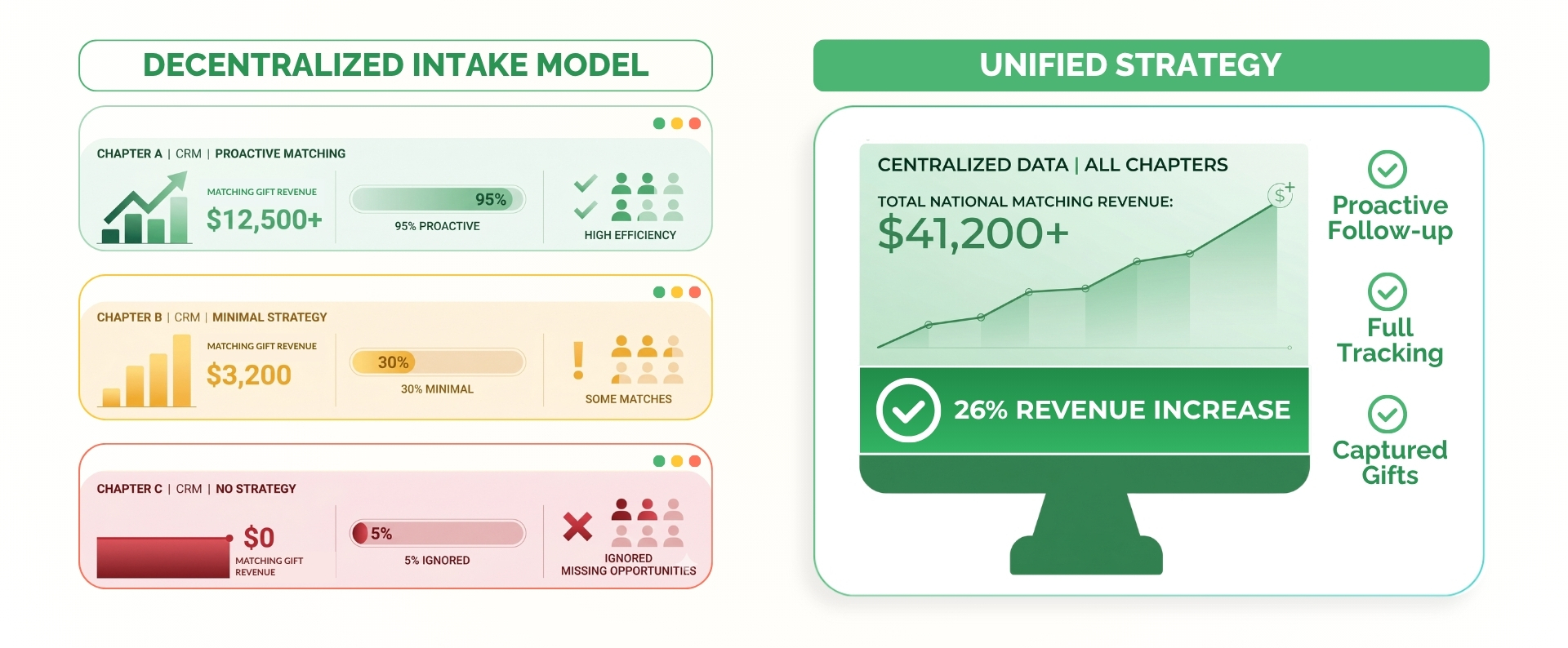
Beyond revenue, this transition also improves the donor experience. Supporters often feel frustrated when they receive redundant or conflicting communications from different parts of the same organization. A unified model enables seamless omnichannel marketing, where your message is consistent across your website, email, social media, and more. This professional approach encourages donors to engage deeply with your mission over time.
Strategy #2. Integrating Workplace Giving in the Donor Journey
Our second strategy involves embedding workplace giving opportunities directly into the initial engagement process. Many organizations treat workplace giving as an afterthought, sending a follow-up email days or weeks after a gift is made. However, the most effective way to unify data is to collect employment information at the point of involvement. This ensures that the data is ready for immediate action (and stored within their record), whether it came through a giving form or volunteer registration.
The result? Unlocking multiple streams of workplace giving revenue with a single data point!
Here’s how you can implement this step:
- Donation Pages: Include a company search tool to identify matching gift eligibility.
- Volunteer Registrations: Embed the search tool in your signup forms to determine which volunteers are eligible for volunteer grants or VTO.
- Confirmation Pages: Provide direct links to the employer’s workplace giving submission portal to streamline next steps.
- Thank You Emails: Mention the specific programs they may qualify for (matching gifts, volunteer grants, payroll giving, etc.) based on their employer.
Keep in mind that a manual data entry process is prone to errors and delays. By using integrated technology, you can ensure that the moment a donor identifies their employer, your system is ready to guide them through the submission process. This level of support makes workplace giving feel like a natural part of the journey rather than an extra chore.
Strategy #3. Utilizing Comprehensive Automated Technology
The third and perhaps most critical strategy involves investing in dedicated workplace giving software that automates data unification. Managing corporate philanthropy programs manually is a Herculean task, especially for large organizations with thousands of donors. Automation tools like Double the Donation work in the background to identify eligible gifts, send reminders, and track progress to completion without requiring constant staff intervention.
Plus, automation does more than just save time. It also increases the accuracy of your data. These platforms maintain massive databases of corporate giving programs, ensuring your organization always has the most current information on match ratios, minimums, deadlines, and other guidelines. And when your fundraising tools communicate through integrations, the data remains clean and actionable across your entire tech stack.
For example, Double the Donation’s Volunteering module helps identify supporters who qualify for volunteer initiatives. By unifying volunteer data with your organization’s broader donation data, you can identify which supporters provide the most holistic value. This comprehensive view allows you to steward supporters more effectively and thank them for the diverse ways they contribute to your cause.
How to Overcome Common Implementation Barriers
While the benefits of unifying your data are clear, many nonprofits face internal resistance when implementing these changes. Overcoming these barriers requires strong leadership and a clear focus on the long-term mission of maximizing impact.
Navigating Internal Resistance
One of the most common mistakes nonprofits make when it comes to unifying workplace giving data is departmental silos. Different units, such as the volunteer department or the events team, may feel protective of their specific data and processes. This turf-war mentality can slow the centralizing process and lead to fragmented donor records.
To solve this, leadership must emphasize that a rising tide lifts all boats. When matching gift revenue increases through data improvements, those funds can be allocated to the programs that generated them. Showing how centralization benefits each department by providing a 360-degree view of their supporters can help gain internal buy-in.
Addressing Data Privacy and Security Concerns
Data privacy is a paramount concern for any nonprofit professional handling sensitive donor information. Some may worry that moving data from chapter-specific spreadsheets into a unified database increases the risk of a breach. This fear can lead to hesitation in adopting the very tools needed for growth.
The solution lies in selecting reputable software providers that offer high levels of security. Double the Donation, for example, utilizes secure integrations and verified data sources to ensure donor information is protected. By using professional tools instead of manual spreadsheets, you actually increase your security by storing data in encrypted, SOC 2-compliant environments.
Managing the Perceived Cost of New Technology
Budget constraints are a reality for every nonprofit, and the perceived cost of new software can be a significant barrier. Leadership may hesitate at the price of an automation platform, focusing on the upfront expense rather than the long-term ROI. This immediate thinking often costs the organization more over time.
The best way to overcome this barrier is to look at the hidden cost of manual data management. For example, an increase in matching gift revenue can represent hundreds of thousands of dollars. Compared with millions in unclaimed corporate funds, technology cost is a minor expense that pays for itself many times over.
Solving the Challenge of Manual Data Entry
For organizations without automated systems, the sheer volume of data can be overwhelming. Entering employer information and tracking match requests by hand is a Herculean task that is prone to human error. This administrative burden often leads to data fatigue, where staff members stop collecting information because they lack an efficient strategy.
Strategic automation is the only sustainable solution to this barrier. By integrating workplace giving tools directly into your online forms and supporter database, you eliminate the need for manual entry. The platform captures information at the source and updates records systematically. This shift allows your development team to stop acting as data entry clerks and start acting as strategic fundraisers.
Organizational Success: Crohn’s and Colitis Foundation
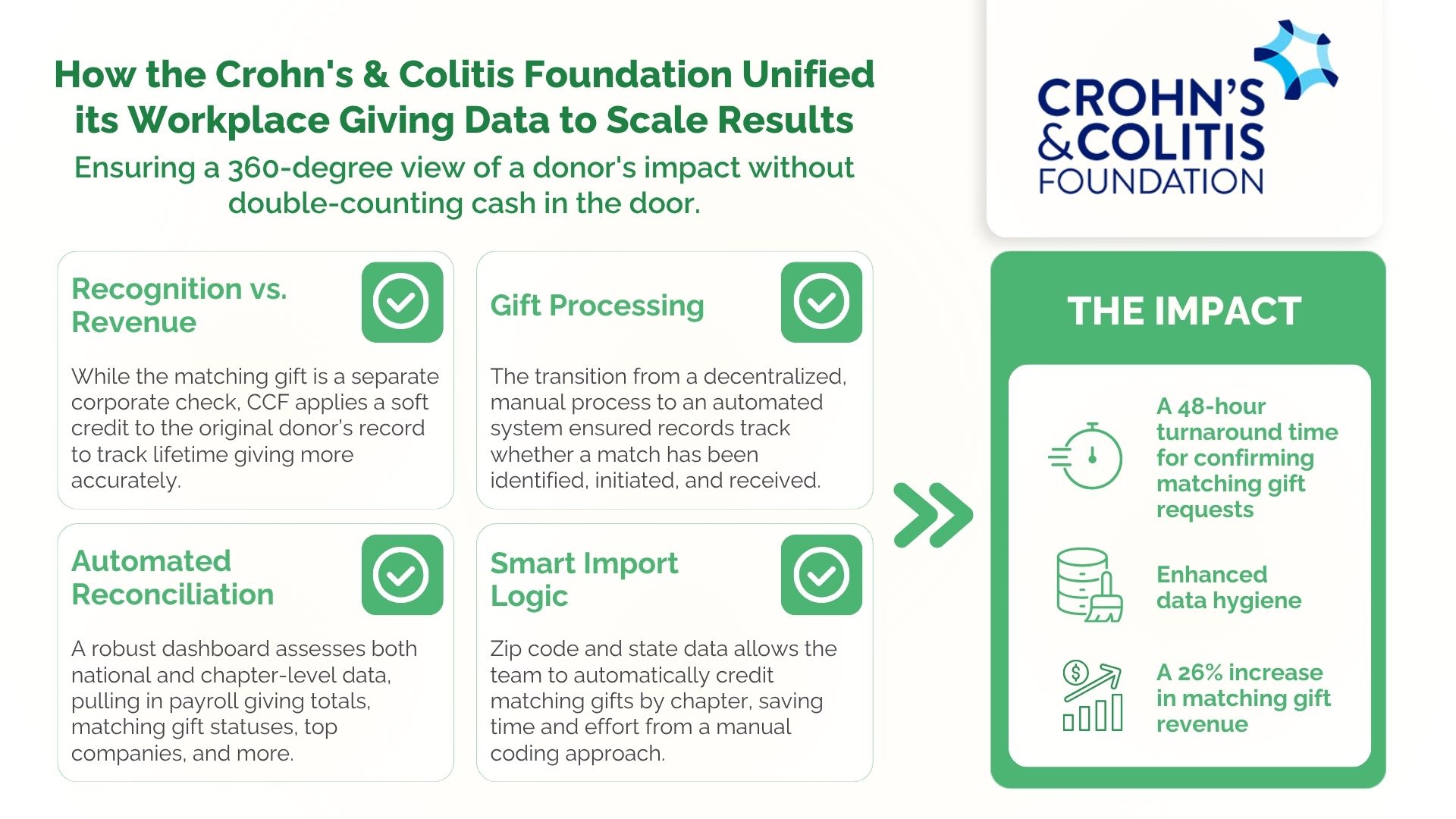
The Crohn’s and Colitis Foundation (or CCF) serves as a prime example of how data centralization yields tangible results. Previously, the foundation operated under a decentralized structure in which individual chapters managed their own intake of matching gift data. However, this approach led to inconsistencies in how gifts were tracked and pursued. Recognizing the need for a more efficient system, CCF decided to centralize its workplace giving at the national office level.
By consolidating their accounts and using a unified software platform, Crohn’s and Colitis ensured that every donation made at the local level was screened for matching gift eligibility by the national team. This eliminated administrative burden on chapter staff, allowing the larger office to use expert knowledge to navigate corporate giving portals. The results were immediate and impressive.
Following this strategic shift, the Crohn’s and Colitis Foundation saw a
26% increase in matching gift revenue.
By empowering a central team to handle the technical aspects of workplace giving, the foundation unlocked millions of dollars in previously untapped support.
Interested in accessing more insights from CCF’s matching gift journey? Check out this recent blog to dive deeper into their approach.
Next Steps: Mastering Workplace Giving Data Consolidation
Unifying your donation and workplace giving data is a transformative step for any nonprofit. By moving away from decentralized models, integrating giving opportunities into the donor journey, and leveraging automation, you can unlock significant new revenue streams.
The Crohn’s and Colitis Foundation’s success demonstrates that centralizing data is a winning strategy for increasing impact. Is your team ready to follow in their footsteps? Start small by auditing your current intake processes, then look for technology solutions to bridge gaps across your departments. The effort you invest in centralizing your data today will pay dividends in the form of a more engaged supporter base and a more financially resilient organization tomorrow.
Unify Your Workplace Giving Data (& Raise More) With Double the Donation
Stop letting corporate revenue slip through the cracks. Join 8,000+ organizations in using the #1 workplace giving automation suite to power their growth.


