Tag Archive for: adam weinger

How To Use Tech to Support Your Corporate Volunteer Strategy

How To Use Tech to Support Your Corporate Volunteer Strategy

Modern professionals demand more than just a paycheck; they require purpose. They view their employer’s CSR benefits (such as Volunteer Grants and Volunteer Time Off) as essential parts of their compensation packages. As a result, today’s employees have the freedom to choose the causes that resonate with them personally.

This presents a massive opportunity, but also a logistical challenge for nonprofits and CSR leaders alike. When thousands of employees are empowered to volunteer at thousands of different organizations, how do you track your impact? How do you ensure utilization of benefits? And, most importantly, how do charitable organizations capture the revenue associated with these hours?

The answer lies in technology.

To thrive in this new environment, organizations must leverage the right tools to uncover corporate volunteer opportunities, streamline validation processes, and bridge the gap between employee intent and corporate impact. And the result? The monetization of volunteer efforts in a new and powerful way.

The Era of Employee Choice: Why It Matters

Before diving into the technology, it is vital to understand the “why” behind this strategy. The decentralization of corporate volunteering is driven by a desire for autonomy.

An employee in the accounting department might be passionate about animal welfare, while a developer in IT cares deeply about STEM education for underrepresented youth. If a corporation forces both to volunteer at a food bank, engagement drops. However, when companies offer “open” volunteer grant programs (in which the company donates money for every hour an employee volunteers at any eligible 501(c)(3)), participation skyrockets.

The Implications for Nonprofits:

This freedom of choice means nonprofits are no longer just pitching to a corporate CSR manager. Rather, they are pitching corporate volunteer recruitment to every single individual employee. You are competing for their time and the grant dollars associated with it.

  • The Benefit: You have access to a much wider pool of potential corporate funds without needing a formal partnership with the headquarters.
  • The Challenge: You need a way to identify which of your existing volunteers have these benefits and remind them to use them.

This is where technology stops being a luxury and starts being a necessity. You cannot manually survey every volunteer about their benefits package, especially within a large organization. For this reason, you’re going to need a tech-enabled strategy to identify, capture, and monetize this decentralized volunteerism.

Uncovering Hidden Revenue with Smart Tech Integration

The primary reason corporate volunteer strategies fail to generate revenue is a lack of awareness, not a lack of generosity.

Research consistently shows that while over 40% of Fortune 500 companies offer volunteer grant programs, participation rates remain low overall. Why? The employee often doesn’t realize the program exists or forgets to log their hours in their company’s portal.

To support a robust corporate volunteer strategy, nonprofits must integrate volunteer technology that serves as a “detective,” automatically uncovering these hidden opportunities.

1. The Power of “Just-in-Time” Discovery

Your volunteer intake forms and event registration pages are the front lines of your strategy. By integrating a volunteer grant search tool directly into these digital touchpoints, you capture the right data when intent is highest.

Imagine a volunteer signing up for a Saturday shift. As they type their employer’s name (e.g., “Microsoft”) into a search widget on your registration form, the technology immediately flags that Microsoft pays $25 per volunteer hour.

  • Without Tech: The volunteer shows up, works, and leaves. The nonprofit gets the labor but misses the funds.
  • With Tech: The volunteer is presented with a pop-up or auto-email explaining that their 4-hour shift is worth $100 to the organization. From there, they receive a direct link to the Microsoft submission portal, along with instructions for completing the simple steps.

This immediacy is crucial. By using tech tools to present information to the volunteer beforeduring, or soon after their engagement, you drastically increase the likelihood of a successful grant submission.

2. Employer Appends and Data Enrichment

Many organizations sit on a goldmine of volunteer data that lacks context. You may have a list of 5,000 past volunteers, but if you don’t know where they work, you can’t monetize their time.

Modern data services, often called “employer appends,” use technology to scan your existing database and match email addresses or names with up-to-date employment information. This allows you to segment your audience, such as identifying a cluster of 50 volunteers who all work for Home Depot.

With this insight, you can launch a targeted digital campaign: “Did you know Home Depot offers a volunteer grant program? Your collective 200 hours of service last year could translate into more than $5,000 for our cause. Here is the link to submit.”

This turns a simple “thank you” email into a revenue-generating activation.

Leveraging Volunteer Time Off (VTO) Benefits

One of the most underutilized assets in the corporate sector is Volunteer Time Off (also known as VTO). This is distinct from a volunteer grant; VTO is essentially paid time off granted by the company specifically for volunteer work.

In a competitive labor market, companies are expanding VTO policies to attract talent. However, many employees hesitate to use it because they don’t know how to schedule it or feel guilty stepping away from their desks.

How Tech Supports VTO Strategy

To help bridge the Volunteer Time Off gap, your technology needs to act as a proactive planner. By integrating Double the Donation Volunteering’s tools, you can automate the discovery and reminder process, turning a passive benefit into confirmed attendance.

Here’s how:

  • Data Capture at Registration: The most critical step in leveraging VTO is identifying eligibility the moment a volunteer expresses interest. Luckily, Double the Donation’s tools integrate directly into your existing volunteer registration forms. As a user signs up for a shift, they can search for their employer using the embedded widget. This immediately captures their employment data and flags whether their company offers a VTO policy, removing the guesswork for your team.
  • Pre-Event Automated Outreach: Once employment information is captured, timing is everything. Instead of waiting until after the service is complete, the software allows you to automate outreach before the scheduled shift. If a volunteer is identified as working for a company with a VTO program, the system can trigger a personalized email encouraging them to secure approval from their manager or HR department ahead of time.

By making it technologically seamless to identify VTO eligibility and remind volunteers to use it, nonprofits can significantly increase volunteer attendance during standard business hours and other hard-t0-fill shifts.

The “Dollars for Doers” Ecosystem

To truly support a corporate volunteer strategy, one must understand the financial mechanics of “Dollars for Doers” or volunteer grants.

The data is compelling. 80% of companies with these programs offer between $8 and $15 per hour, while some go significantly higher. For a nonprofit, this means that a solid volunteer strategy is actually a donor acquisition strategy.

The Tech-Enabled Workflow

And, of course, the right technology can go a long way. Here’s how equipping your volunteer engagement team with the proper tools will help power your corporate volunteer strategy and diversify your nonprofit revenue:

  1. Identification: A volunteer registers online. The Double the Donation widget identifies the individual as “Volunteer Grant Eligible.”
  2. Automation: 24 hours after the shift, your fundraising software triggers an automated email.
    • Subject: You made a difference + You can double it!
    • Body: “Thank you for volunteering 5 hours for our cause. Because you work for [Company Name], those hours are eligible for a $100 grant. Click here to submit your request in less than 2 minutes.”
  3. Tracking: The software tracks the “open” opportunity until the funds are received, allowing the nonprofit to report on “Volunteer Generated Revenue.”

This workflow removes the burden from the nonprofit volunteer coordinator, who is likely already stretched thin. It puts the process on autopilot, ensuring that as long as volunteers show up, revenue requests are generated.

Making the Case to Corporate Partners

While current trends increasingly favor employee choice, direct corporate partnerships still exist. However, the expectations have changed.

Corporate CSR leaders are increasingly data-driven. These teams need to justify their budgets to their C-suites. When a corporation considers partnering with a nonprofit, they want to know: “Can you handle our people, and can you effectively report on their impact?”

Technology allows you to say “Yes” with confidence. Here’s how:

  • Leverage Data to Pitch Formal Partnerships: Rather than cold-calling, use your Double the Donation dashboard to identify which corporations are already represented in your volunteer base. Approaching a CSR director with the insight that “50 of your employees already volunteer with us” transforms a cold pitch into a warm, data-backed conversation about formalizing a group event or sponsorship.
  • Branded Landing Pages: You can quickly spin up a registration page specifically for “Bank of America Volunteers” using your dedicated volunteer management software.
  • Real-Time Impact Dashboards: Instead of sending a static spreadsheet a few months post-event, provide corporate partners with digital dashboards that show the total hours volunteered, the number of employees engaged, and the monetary value of that time.

By demonstrating that you have the tech stack to support their engagement strategy, your organization becomes a lower-risk, higher-value partner for major corporations and other impact-focused businesses.

Case Studies in Tech-Enabled Corporate Volunteerism

Success in this arena isn’t theoretical. Leading organizations are already using these digital strategies to uncover opportunities and drive revenue.

Let’s check out a few powerful examples!

1. The “Education Hub” Approach (Long Island Cares)

Long Island Cares recognized that their volunteers wanted to help but didn’t know the rules. Therefore, they decided to use their website as an education hub. By embedding a search tool directly under their main navigation, they made “Check your eligibility” a core part of the volunteer journey.
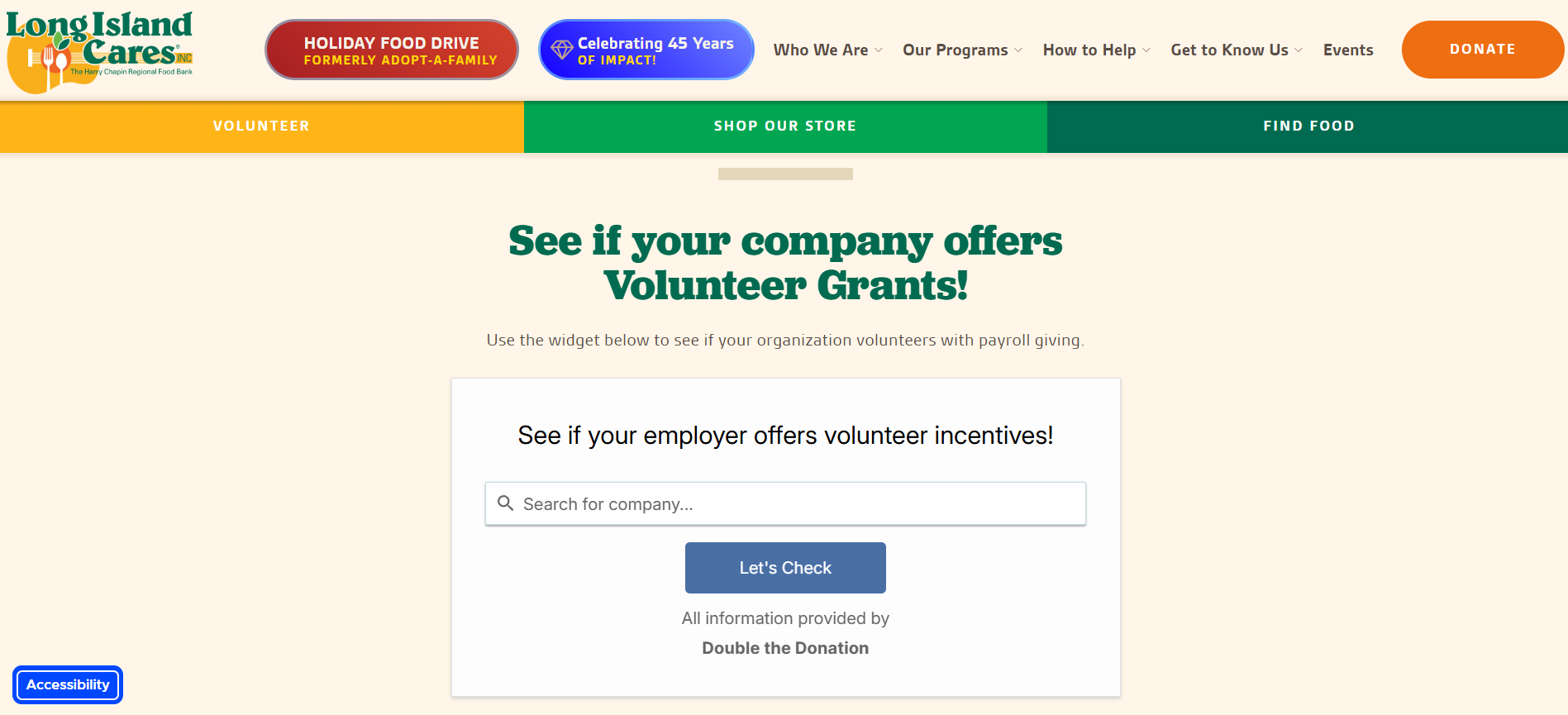
A look at Long Island Cares' corporate volunteer strategy

The Tech Win: They didn’t bury the information in a PDF; they made it interactive and searchable, capturing intent (and opportunity) instantly.

Explore more of Long Island Cares’ corporate volunteer strategy here.

2. Quantifying Value (Veterans Community Project)

Veterans Community Project does an incredible job of using its data to tell a compelling story. The organization explicitly states the monetary value of its volunteers on its impact pages (totaling more than $827,000 in a single year).
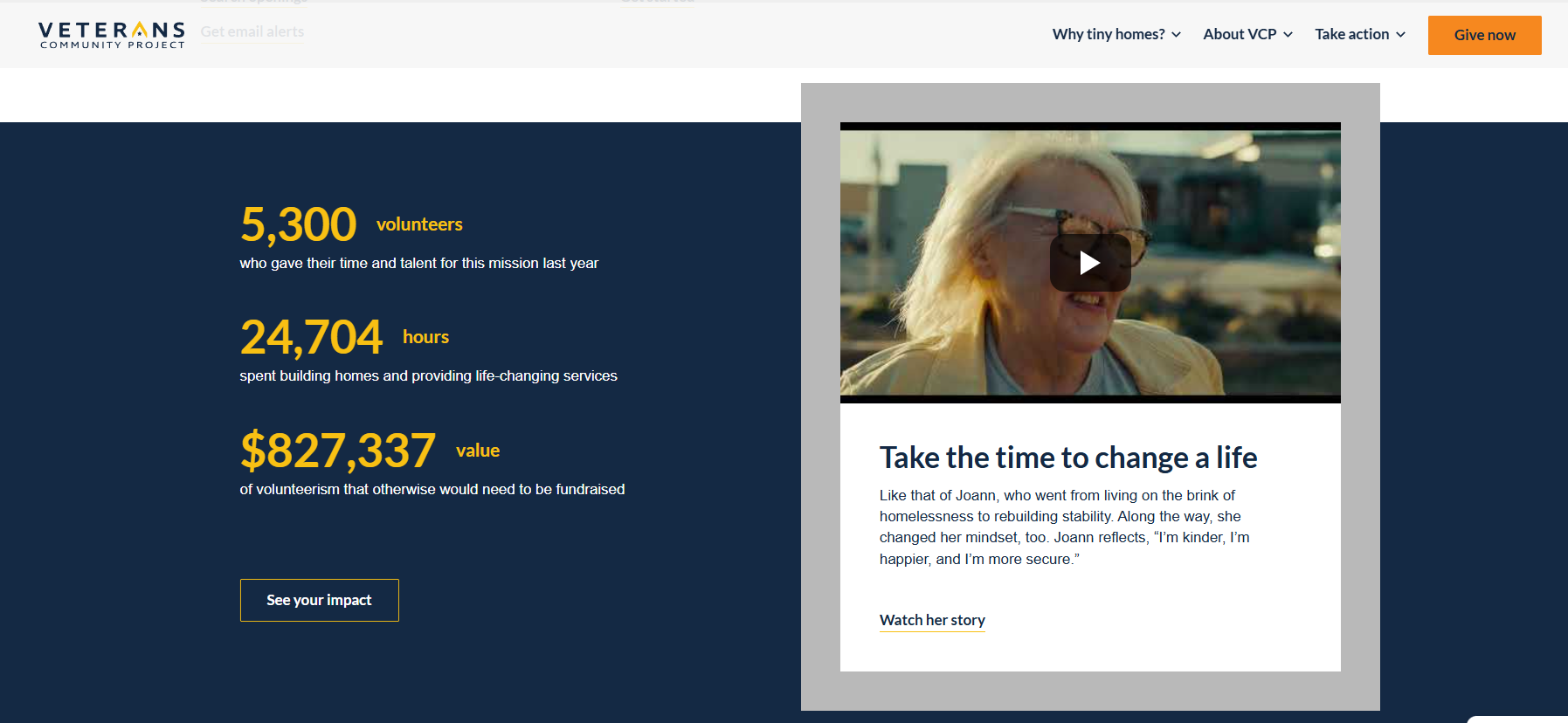
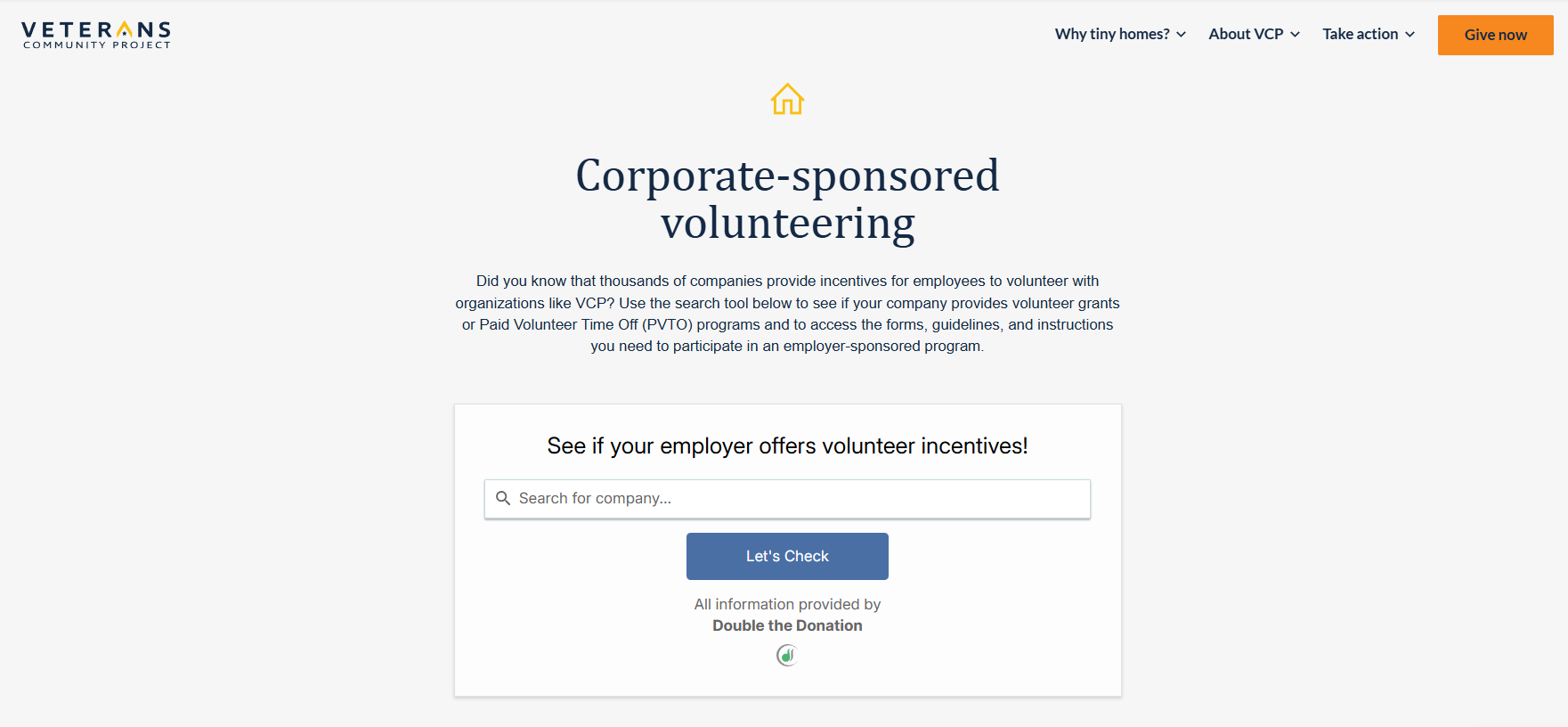
A look at Veterans Community Project's corporate volunteer strategy

A look at Veterans Community Project's corporate volunteer strategy

The Tech Win: By tracking hours digitally and assigning a tangible dollar value to them, they prime the pump. When they ask a volunteer to submit a grant request, the volunteer already understands that their time has financial worth. They also use their site to educate employees about Paid Volunteer Time Off (PVTO), giving them the green light to skip work for a good cause.

Explore more of Veterans Community Project’s corporate volunteer strategy here.

3. Removing Friction (Carolina Tiger Rescue)

The biggest enemy of volunteer grants is friction in the process. If a volunteer has to hunt for a Tax ID, a mailing address, or a contact email, they will likely abandon the submission altogether. Luckily, Carolina Tiger Rescue counters this obstacle by placing all necessary legal and contact data right next to the actionable search tool.
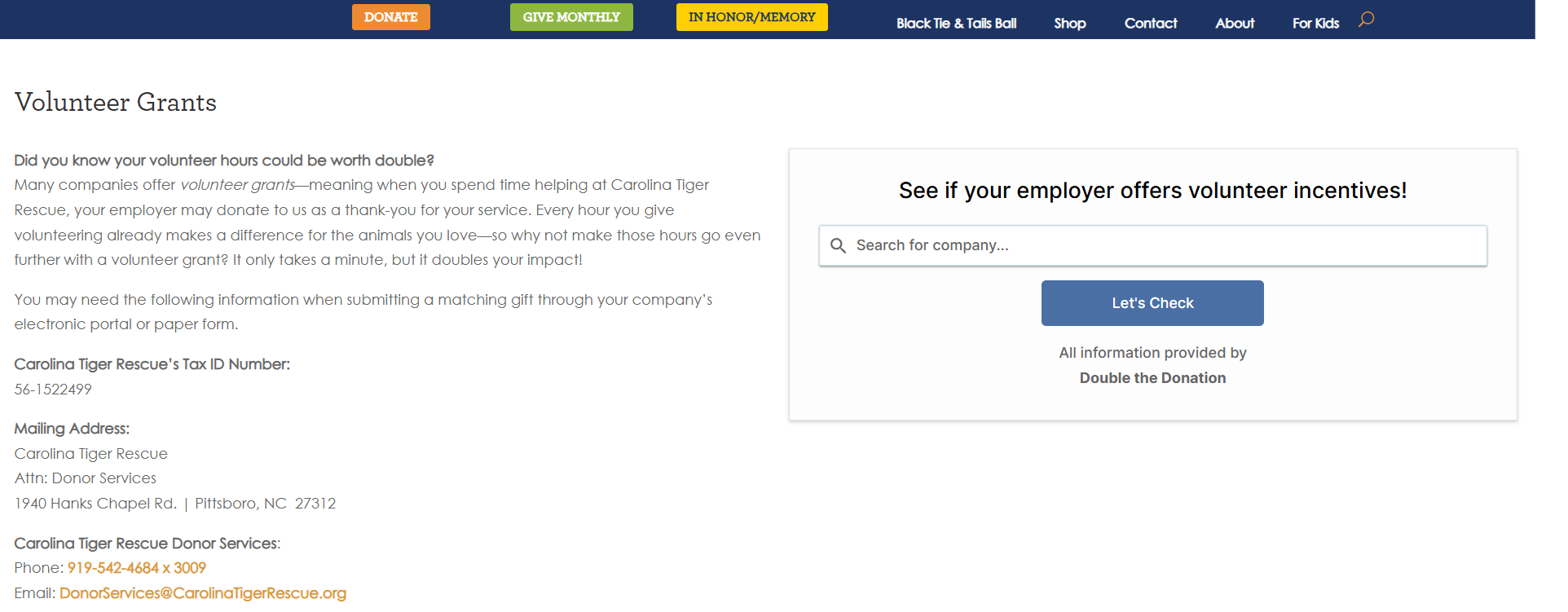
A look at Carolina Tiger Rescue's corporate volunteer strategy

The Tech Win: This organization fully anticipates the user’s needs. The technology provides the “eligibility” answer, and the static content provides the “submission” details. It’s a seamless handoff with great results.

Explore more of Long Island Cares’ corporate volunteer strategy here.

5 Steps to Implement a Tech-Forward Volunteer Strategy

If you are ready to pivot from a passive volunteer program to an active, revenue-generating strategy, follow this step-by-step roadmap:

Step 1: Audit Your Digital Intake.

Review your volunteer registration forms, waivers, and event sign-ups. If you’re not asking for employer information (or better yet, providing a search tool to validate it), you are essentially flying blind. Add the field immediately to kick things off.

Step 2: Automate the Ask.

Do not rely on your volunteer coordinator to remember to ask for volunteer grants. Instead, implement an automated email sequence that triggers after a volunteer completes a shift. The message should be simple: “Did you know your time is worth money? Here is how you can submit.”

Step 3: Promote “Total Giving.”

Update your website copy to reflect the modern corporate benefits package. Use language like “Maximize your Employee Benefits” or “Use your VTO here.” Frame volunteering not just as “helping our cause,” but as “utilizing the perks you earned at work.”

Step 4: Segment Your Communications.

Stop sending generic emails. Use your tech tools to segment volunteers by employer. Send a targeted blast to all employees of a major bank in your area, or those who work for a certain corporate giant, highlighting their specific grant programs.

Personalized communication drives higher conversion.

Step 5: Report and Refine.

Use your dashboard to see which companies are searching for you. If you see 100 searches from “Target” employees but zero grants are actually completed, you know you have a submission bottleneck. If you see high search volume from a specific business, reach out to their local CSR office to formalize a partnership, letting the data dictate your outreach.


Conclusion

The corporate volunteer landscape has evolved. It is more democratic, more flexible, and more potential-rich than ever before. But with that freedom comes fragmentation.

Nonprofits can no longer wait for a centralized directive from a corporate headquarters to send funding their way. They must empower the individual employee to act. By leveraging innovative technology to identify eligibility, educate supporters, and automate the submission process, you can transform your volunteer program from a simple labor source into a sustainable, diversified revenue stream.

The employees have the freedom to choose where they give their time. Use technology to make sure they choose you, and that they bring their corporate dollars with them.

Ready to get started? Reach out to Double the Donation to learn more about how their industry-leading software can help power your corporate volunteer strategy.

Nonprofit Revenue Diversification 5 Sustainable Funding Streams

Nonprofit Revenue Diversification: 5 Sustainable Funding Streams

In the current economic landscape, relying on a single source of funding is a risky strategy for any charitable organization. Market fluctuations, shifting donor priorities, and changes in government policy can suddenly destabilize even the most established nonprofits. If 80% of your funding comes from one annual gala or a specific government grant, your mission is vulnerable. To build long-term resilience, forward-thinking leaders must actively pursue nonprofit revenue diversification.

Revenue diversification is not just about receiving more money; it is about finding different kinds of money. By cultivating multiple distinct income streams, your organization can smooth out financial peaks and valleys, ensuring it has the resources to fulfill its mission regardless of external conditions. A diverse portfolio reduces risk and allows you to plan for the future with confidence rather than fear.

In this comprehensive guide, we’ll cover:

Let’s explore how you can implement these strategies to build a more robust financial future for your organization.

The Strategic Value of Revenue Diversification

Many nonprofit leaders view revenue diversification as a luxury, or something to tackle “when we have time.” However, it is actually a fundamental component of risk management. A diversified revenue model creates a safety net. If individual giving drops during a recession, revenue from corporate contracts or foundation grants can sustain operations. If a major grant expires, recurring monthly donors provide a baseline of support.

Beyond financial stability, diversification often opens doors to new networks and audiences. Engaging with corporations for grants introduces you to their employees who are willing to volunteer. Launching a challenge match engages major donors while simultaneously motivating smaller, individual givers. It is a holistic approach that strengthens your entire fundraising ecosystem.

Furthermore, different revenue streams come with different restrictions. Grants are often restricted to specific projects, while individual donations are frequently unrestricted. By balancing these sources, you ensure you have the cash flow to cover overhead costs like rent and salaries, which are often harder to fund solely through grants.

Workplace (or Employee-Led) Giving Programs to Note

Workplace giving is one of the most efficient ways to build a sustainable revenue pipeline. These programs allow employees to support nonprofits through their employers, often with the help of automated platforms. Because these funds often come from corporate budgets or payroll deductions, workplace giving programs provide a reliable layer of support that complements individual giving.

Unlike a one-time event, workplace giving builds long-term relationships among donors, employers, and your nonprofit.

Corporate Matching Gifts

Matching gifts are often considered the cornerstone of workplace giving and represent one of the largest untapped sources of revenue for nonprofits. In these programs, companies match their employees’ donations to eligible nonprofits with cash. This effectively doubles the impact of a single donation without requiring the donor to give more from their own pocket.

Despite their value, these funds are often underutilized due to a lack of awareness. Donors simply do not know their employer offers the program, or they find the process too cumbersome. However, the potential impact is massive. According to Double the Donation’s matching gift statistics, 84% of donors say they are more likely to donate if a match is offered, and 1 in 3 say they would give a larger gift if a match is applied.

To capture this revenue, organizations must move beyond passive hope. Integrating a fundraising tool that identifies match-eligible donors during the donation process is critical. When a donor sees a prompt like, “See if your company will match this gift,” they are reminded of the opportunity at the moment of peak engagement.

Did You Know?

An estimated $4 to $7 billion in matching gift revenue goes unclaimed every year. This isn’t because companies don’t want to give; it is because donors don’t submit the paperwork. Using a matching gift database can help you automatically identify these prime opportunities.

Employee Volunteer Grants

Time is money, especially when volunteer grants are involved. Also known as “Dollars for Doers,” these workplace giving programs incentivize volunteerism by awarding monetary grants to nonprofits where employees volunteer. For example, a company might donate $500 to a nonprofit after an employee logs 20 hours of service. This turns your volunteer program into a revenue-generating asset with ease.

These grants are particularly valuable because they honor the commitment of your most dedicated supporters: those who give their time. Companies like Verizon, Microsoft, and Google all have robust volunteer grant programs. To capitalize on this, ensure your volunteer coordinators ask volunteers about their employers during onboarding and registration, and educate them on how to submit their grant requests. You should also track volunteer hours meticulously, as companies will likely require verification before releasing funds.

Automated Payroll Giving

Payroll giving allows employees to donate a portion of their regular paychecks directly to a nonprofit. Because these donations are often deducted pre-tax, it lowers the donor’s taxable income while providing your organization with a steady, predictable stream of unrestricted revenue. It is a “set it and forget it” method that encourages long-term engagement.

This method of giving boasts incredibly high donor retention rates because donations occur automatically. The donor does not have to remember to write a check or enter their credit card information every month. To grow this stream, ask your corporate partners to include your nonprofit on their annual giving campaign list. Being a featured charity during a company’s “giving season” can lead to a significant influx of new and recurring donors.

Corporate Grants for Nonprofits

While workplace giving engages individual employees, corporate grants come directly from a company’s philanthropic budget or foundation. These contributions are typically awarded to organizations that align with the company’s values or corporate social responsibility (CSR) goals. Unlike government grants, which can be overly bureaucratic and slow, corporate grants often have more flexible application processes and faster turnaround times.

There are generally two types of corporate giving buckets to look for: corporate foundations and marketing/community relations. Foundations usually have strict guidelines and grant cycles, whereas community relations budgets can be more discretionary and used for local sponsorships or immediate community needs.

How to Secure Corporate Grants

Securing a corporate grant requires thorough research and alignment with the mission. For the best results, you must demonstrate how your cause supports the company’s own objectives. Does a business focus on STEM education? Environmental sustainability? Hunger relief? Your proposal should speak their language.

To get started, take a look at businesses in your local community or companies that have a history of giving to your cause. Review their CSR reports to understand their funding priorities. Once you identify a prospect, tailor your proposal to highlight mutual benefits. Show them exactly how their funding will create a tangible impact that they can share with their stakeholders to make a difference.

Additionally, you can also look for companies that offer “in-kind” or non-monetary support. In-kind donations for nonprofits (such as donated technology, office space, or professional services) can significantly reduce your operating costs, freeing up cash for other programs. For example, a local law firm might offer pro bono legal services, or a tech company might donate refurbished laptops for your staff. Then, the money you would have spent can go directly to your mission recipients.

Quick Tip

Don’t just look at the “Big Three” corporations in your city. Mid-sized local businesses often receive fewer grant applications, resulting in less competition and a higher likelihood of success for your proposal.

Challenge Match Fundraising Opportunities

A challenge match is a high-impact fundraising strategy that leverages a major gift to inspire smaller donations. In this scenario, a major donor (or a group of donors, such as your board of directors) agrees to donate a substantial sum, but only if the nonprofit raises an equivalent amount from other supporters within a specific timeframe.

This strategy diversifies revenue by bridging the gap between major giving and annual fund appeals. It energizes your base by establishing a sense of urgency and maximizing the value of their contributions. For a donor who can only give $50, knowing their gift will unlock an additional $50 creates a powerful incentive to act. It transforms a standard donation into a strategic investment.

Structuring a Successful Challenge

To launch a challenge match, you first need to identify an “anchor” donor. This is someone who has the capacity to give a large gift and is passionate about motivating others and increasing the ROI of their own financial investment. Try framing the challenge around a specific campaign or goal, such as “Help us raise $50,000 in 24 hours to fund our new summer camp.”

As you do so, remember that clear communication is vital. Use email, social media, and your website to track progress in real-time. A visual thermometer showing progress toward the objective is a classic but effective tool. You need to show donors exactly how close you are to unlocking the match funds. If the goal isn’t met, you typically still keep the donations raised, but you lose the matching funds (depending on the agreement), which adds a layer of healthy pressure.

These campaigns are also excellent for re-engaging lapsed donors. The message “Continue supporting our cause and have your impact doubled” is often enough to win back supporters who haven’t been involved for a year or two.

Best Practices for Successful Implementation

Diversifying your revenue is a marathon, not a sprint. Don’t try to launch every new stream at once, or you risk burning out your development team. Instead, start by auditing your current donor data to identify the “low-hanging fruit.” Are there many donors working for matching gift companies? Focus on corporate giving first. Do you have a strong relationship with a major donor? Pitch a challenge match.

Train Your Team on Every Revenue Stream

Revenue diversification is not just a job for the development director; it is an organization-wide mindset. Yet many nonprofit staff members are fluent only in one or two languages of giving. A major gift officer might be an expert in cultivating individual relationships but know very little about workplace giving. A program manager might interact with volunteers daily but not know how to ask if their employer offers a volunteer grant.

To truly build a diversified funding model, you must cross-train your team. Schedule a lunch-and-learn session dedicated solely to “hidden” revenue sources. Teach your volunteer coordinators the basics of volunteer grants so they can spot opportunities in the field. Ensure your frontline fundraising staff know how to explain matching gifts to donors in 30 seconds or less. When your entire team (from the receptionist to the board chair) understands the full menu of giving options, you effectively multiply your fundraising workforce.

Quick Tip

Create a simple one-page “cheat sheet” for your staff that lists your top 5 revenue streams, including key stats and a one-sentence “ask” for each. This ensures that no matter who is talking to a donor, the message remains consistent and opportunity-focused.

Leverage Optimized Data and Technology

You cannot effectively diversify revenue if you don’t know who your donors are. That’s why investing in the right technology is crucial. Luckily, fundraising software that automates corporate gift matching or tracks volunteer hours can scale these programs without adding administrative burden.

Additionally, employer appends can help you find out where your donors work. This process involves scanning your existing donor database against external datasets to identify employment information. If you discover a cluster of donors working for the same local business, that company is a prime candidate for a sponsorship proposal or a payroll giving partnership.

“Stack” Revenue Streams to Amplify Impact Further

One of the most powerful aspects of diversification is that these revenue sources are rarely mutually exclusive. In fact, the most successful organizations actively look for ways to layer different streams on top of one another to maximize the value of a single interaction. This concept is best illustrated by the “triple match” strategy.

Consider a scenario where you have secured a challenge grant from a major donor who agrees to match all contributions made during a 24-hour giving day. During that window, a supporter donates $100 to your campaign, and the challenge grant converts that to $200 immediately. However, if that supporter works for a company with a matching gift program, they can submit a request to their employer to match their original $100 donation as well.

The result is that a single $100 gift generates $100 from the challenge grant and another $100 from the corporate employer, totaling $300 in revenue for your mission. By educating your donors about this possibility, you empower them to triple their impact without giving an extra cent from their own bank account. This messaging is incredibly compelling and can significantly boost conversion rates during time-bound campaigns.

Incorporate Strategic Stewardship and Reporting Practices

Finally, always steward your partners. Whether it is a corporation providing a grant, a major donor funding a challenge, or an employee giving through payroll, regular communication about the impact of their support is essential for retention. In other words, you must close the loop.

Send impact reports that are specific to the revenue stream. For a corporate sponsor, report on how many people saw their logo. For a challenge grant donor, share information on how many new donors were acquired during the campaign. Show them that their diverse contributions are making a unified difference for your overall mission.

FAQs About Nonprofit Revenue Diversification

Have questions? We’ve got answers! Here are some of the most common inquiries regarding revenue diversification strategies from nonprofits like yours.

What is the easiest revenue stream for an organization to incorporate?

Matching gifts are often the easiest starting point because the donors are already giving to you. You don’t need to find new donors; you simply remind your existing ones to submit a request to their employer. And best of all, this process can be automated with the right software.

How do I find out if my donors are eligible for workplace giving?

The most effective method is using a search tool on your donation form or confirmation page. You can also use employer appends services to analyze your existing database and identify donor employment information retrospectively.

Do small nonprofits qualify for corporate grants?

Yes! Many corporations have local giving arms specifically designed to support small, community-based organizations. You do not need to be a national charity to receive funding from a local branch of a bank or a retail store.

What other forms of nonprofit revenue might my organization consider?

Beyond workplace giving and corporate grants, there are several other sustainable revenue streams to explore. These may include:

  • Government grants, which are excellent for funding specific public services
  • Earned income, such as selling merchandise, event tickets, or charging fees for services, which can provide valuable unrestricted cash
  • Membership programs, in which supporters pay annual dues for access to exclusive perks
  • Peer-to-peer fundraising, which empowers your current donors to raise money from their own networks on your behalf

Ultimately, the goal isn’t to implement every single one of these strategies overnight. Instead, evaluate your organization’s unique assets and audience to determine which of these additional streams aligns best with your mission.

By gradually incorporating these opportunities alongside your core fundraising efforts, you can build a comprehensive financial safety net that ensures your impact continues, regardless of what the economic forecast holds.


Wrapping Up & Next Steps

Revenue diversification is essential for building a resilient nonprofit that can weather economic uncertainty. By expanding beyond simple individual donations and tapping into workplace giving, corporate grants, challenge matches, and sponsorships, you create a stable foundation for growth. These streams not only provide funds but also deepen relationships with donors and corporate partners alike.

The journey to diversification begins with looking at the resources you already have. Your existing donors are likely eligible for matching gifts or work for companies that offer grants; you just haven’t asked yet. Automation can help you identify and capture these opportunities without adding more work to your plate.

Ready to streamline your corporate giving strategy? Get a demo with Double the Donation today.

How to Involve Matching Gift Donors in More Workplace Giving Programs

How to Involve Matching Gift Donors in More Workplace Giving Programs

For nonprofits looking to maximize their fundraising efforts, engaging matching gift donors in more workplace giving programs can be a game-changer. After all, matching gift programs are just one piece of the puzzle. Many companies offer additional workplace giving opportunities, including volunteer grants, volunteer time off, and payroll deductions. Donors who participate in matching gifts can also be some of your best assets for these other programs, making them a prime audience for further engagement.

In this guide, we’ll explore how to involve matching gift donors in additional workplace giving programs. We’ll cover:

By diversifying the ways matching gift donors engage with your nonprofit, you can increase both the impact of their contributions and the sustainability of your funding model. Let’s dive in to find out how your team can encourage such involvement.

What Are Workplace Giving Programs?

Workplace giving refers to charitable donation programs offered by companies that enable their employees to contribute directly to nonprofits through their workplace. These programs are designed to make it easier for employees to give back to the causes they care about while benefiting from company-sponsored incentives, such as matching gifts or grant funding.

For schools, workplace giving presents a unique opportunity to increase fundraising efforts through established corporate channels. By tapping into these programs, schools can supplement traditional donation methods and cultivate stronger connections with their alumni, parents, donors, and corporate partners.

With the right approach, workplace giving can provide a steady stream of support, benefiting both the institution and its broader community.

Beyond Matching Gifts: Types of Workplace Giving Programs to Consider

Matching gifts are the most readily available form of workplace giving, with 65% of Fortune 500 companies and a wide range of smaller and mid-sized businesses offering the programs. However, they’re not the only kind of workplace giving you should be keeping an eye on.

Many companies offer multiple workplace giving programs, and matching gift donors are often prime candidates for involvement in these additional initiatives. Below, we explore the three key types of workplace giving programs that nonprofits should focus on to further engage matching gift donors.

Volunteer Grants

A volunteer grant is a contribution made by a company to a nonprofit based on the volunteer hours an employee contributes. For example, if an employee volunteers 20 hours at your nonprofit, their employer might provide a $200 grant to your organization. Volunteer grants enable donors to give not only financially but also with their time, providing a significant boost to your nonprofit’s efforts.

By engaging matching gift donors in volunteer grants, you can increase both the financial and time-based contributions your nonprofit receives. Since these donors are already familiar with giving through their company, they may be more likely to participate in volunteer grants.

Volunteer Time Off (VTO)

Some companies offer Volunteer Time Off (or VTO), which provides employees with paid time off specifically for volunteering. This is an excellent opportunity for matching gift donors to deepen their engagement with your organization by contributing their time and talents. Many companies allow employees to take one or two days per year for volunteer purposes, which could directly benefit your nonprofit if you make these opportunities available.

Matching gift donors who are already committed to supporting your cause may be more likely to take advantage of VTO programs, offering both their time and their skills to further your organization’s mission.

Payroll Giving

Finally, payroll giving programs enable employees to make direct donations from their paychecks to a nonprofit organization of their choice. These donations are often made automatically, requiring little effort from the donor. Payroll giving is an easy way for matching gift donors to contribute to your organization on a recurring basis, increasing your nonprofit’s revenue over time. Since these donations are deducted from their salary before taxes, they also offer tax benefits for employees.

Matching gift donors are often well-suited for payroll giving programs because they’re already familiar with giving through their employer. Adding payroll giving to your outreach efforts can significantly boost the involvement of these donors.

Why Matching Gift Donors Are Ideal for More Workplace Giving Programs

Matching gift donors are often the perfect candidates for involvement in additional workplace giving programs. Here’s why:

#1: They Are Already Engaged with the Company’s Giving Culture: These donors are already participating in their company’s matching gift program, demonstrating a commitment to giving back through their work. They’re likely to be open to other workplace giving opportunities such as volunteer grants, VTO, and payroll giving.

#2: They Have Potential for Increased Contributions: By involving these donors in more workplace giving programs, you’re increasing the potential for both their time and financial contributions. For example, a matching gift donor who also participates in payroll giving and volunteer grants could significantly boost your nonprofit’s funding and volunteer capacity.

#3: It’s Easier to Engage with a Known Donor Base: Matching gift donors are already part of your donor base, making them more accessible than new prospects. These donors already trust your organization and are more likely to continue their support through additional programs.

Tips to Involve Matching Gift Donors in Other Workplace Giving Programs

Now that we understand why matching gift donors are well-positioned for involvement in more workplace giving programs, let’s look at strategies for getting them engaged. Here are a few best practices that we recommend:

Create a Strategic Outreach Plan

A strategic outreach plan is essential for engaging matching gift donors in additional workplace giving programs. This should include clear messaging that educates donors on the various programs available, explains how they can participate, and highlights the benefits for both the donor and the nonprofit.

For optimal results, tailor your outreach based on the programs your donors’ companies offer, as well as their previous engagement with your organization.

Educate Donors About Additional Programs

Some matching gift donors may not be aware of the other workplace giving programs their company offers. For this reason, it’s essential to educate donors about these initiatives through targeted email campaigns, dedicated webpages, or in-person events. Provide clear instructions on how to get involved in these additional programs and explain how their participation will help your nonprofit grow.

Promote Other Giving Programs at the Right Time

Timing is critical when introducing donors to new workplace giving programs. For example, after a donor makes a matching gift, you can follow up with information about volunteer grants or payroll giving programs. Remind them of the available benefits and encourage them to take advantage of these opportunities as well to increase their impact on your mission.

Provide Exclusive Incentives for Participation

People love incentives, so consider offering rewards to matching gift donors who participate in additional workplace giving programs. For example, you could create a giving ladder that recognizes donors who participate in multiple programs. In that case, donors who volunteer for a certain number of hours or contribute through payroll giving could be rewarded with exclusive content, special recognition, or invitations to VIP events.

How to Track and Report on Multiple Workplace Giving Programs

Once you start involving matching gift donors in more workplace giving programs, it’s crucial to track and report these contributions effectively. After all, doing so ensures that your nonprofit doesn’t miss out on potential funding and that you can provide comprehensive recognition to donors who participate in several workplace giving initiatives.

As you implement workplace giving tracking and reporting, here are some key metrics to consider:

  1. Total Contributions from New Programs: Measure how much additional revenue is generated through payroll giving, volunteer grants, and VTO.
  2. Increased Donor Retention: Track whether donors who engage in multiple workplace giving programs are more likely to contribute again in the future.
  3. Volunteer Hours: Track the number of volunteer hours contributed by donors who participate in volunteer grant or VTO programs.
  4. Employer Participation: Measure the extent to which employers are matching donations, offering grants, or providing VTO for their employees’ charitable efforts.

These metrics will give you insight into the effectiveness of your engagement strategies and help you refine your approach to workplace giving. For optimal tracking, utilize a donor management system (or CRM) to monitor participation in matching gifts, volunteer grants, payroll giving, VTO, and other initiatives. This system will help you stay organized, report accurately to corporate partners, and provide updates to donors on the impact of their contributions.

Leveraging Technology to Streamline Workplace Giving Programs

The right technology can play a significant role in simplifying the management of workplace giving programs. Tools like Double the Donation can integrate with your donor management system or fundraising platform to streamline the process of tracking matching gifts, volunteer grants, and payroll giving. These resources collect employment information from supporters, automatically identify workplace giving opportunities, and send reminders to donors, making it easier to manage multiple programs at once.

With innovative tools in your toolkit, you can ensure that matching gift donors have a seamless experience, participate in more workplace giving programs, increase engagement, and maximize your nonprofit’s impact.


Wrapping Up & Next Steps

Involving matching gift donors in more workplace giving programs is an effective way to increase their engagement and enhance the impact of your nonprofit. By promoting volunteer grants, payroll giving, and VTO opportunities, you can significantly boost the financial and volunteer support your organization receives.

Remember to track these contributions, educate your donors, and leverage technology to streamline the process. With the right strategies in place, you can turn matching gift donors into long-term, multi-faceted supporters.

Raise more with matching gift automation software