How Planned Giving Tools Scale Donors’ Lifetime Value (LTV)
| How does planned giving impact overall donor lifetime value for a nonprofit (TL;DR)? Modern planned giving tools boost donor lifetime value by capturing non-liquid asset wealth and legacy commitments before pipeline decay occurs. |
For fundraising executives and board leadership (especially those looking to diversify their existing revenue streams), adopting a dedicated planned giving tool transforms standard annual giving programs into compounding multi-generational assets that maximize long-term institutional ROI and secure organizational financial stability.
Let’s begin with why that’s so important.
The Executive Case for Expanding Donor Lifetime Value
From an executive financial perspective, conventional fundraising models have a fundamental structural flaw: they over-index on immediate cash acquisition while neglecting long-term Donor Lifetime Value (LTV). Most development departments spend millions on donor acquisition and annual fund renewal campaigns that yield marginal, incremental growth. However, true institutional resilience and exponential balance sheet growth occur when executive leadership implements a systematic strategy designed to capture final estate transfers.
Incorporating a dedicated planned giving tool into your development operations shifts your institution from a transactional cash-flow model to a compounding wealth-capture strategy. When board members analyze fundraising performance through an ROI lens, the data consistently demonstrates that a donor’s ultimate financial capacity is unlocked through deferred giving vehicles.
In other words, utilizing purpose-built technology to identify, cultivate, and close legacy commitments protects your constituency pipeline against churn and dramatically expands your average donor yield.
How Planned Giving Impacts Supporters’ Overall LTV
When analyzing how planned giving impacts overall donor lifetime value for a nonprofit, executive teams must examine the stark contrast between liquid cash giving and total asset capacity. The average annual donor contributes through liquid disposable income, which currently represents less than 10% of total wealth in the United States. The remaining 90% of wealth is tied up in non-liquid assets, including real estate, retirement accounts, equities, and business interests.
Let’s do some math:
Say a donor who contributes $500 per year over 20 years yields a cumulative cash lifetime value of $10,000. However, when that same individual is presented with accessible legacy options, they routinely leave a bequest of $35,000 to $75,000 or more from their estate.
This single deferred commitment instantly expands the donor’s lifetime value by 350% to 750% without requiring them to increase their annual out-of-pocket budget.
Furthermore, introducing legacy giving concepts early actually increases current annual giving before the individual’s final payout, too. Recent evidence confirms that supporters who make a documented legacy commitment increase their annual fund contributions by more than 77%.
Why? Securing a legacy commitment deepens donor psychological ownership, driving immediate annual giving lift while locking in massive future estate distributions. So the next time your team is conducting prospect research, be sure to look for ideal legacy giving candidates, too!
Donor Lifetime Value Equations + Pipeline Loss Models
To evaluate the precise financial mechanics of legacy integration, fundraising leaders must evaluate standardized LTV equations alongside pipeline loss models. Here are a few of our recommendations:
Standard Donor Lifetime Value Equation
Without legacy integration, standard annual donor LTV is calculated as follows…
- Donor LTV Calculation: LTV = (Average Annual Gift Size × Annual Gift Frequency) × Average Donor Retention Lifetime in Years.
- Standard Operational Example: ($250 per year × 1 gift per year) × 8 years of active retention = $2,000 Total Lifetime Value.
Annual Giving Lift Equation (Calculating the 77% Increase)
When a loyal constituent agrees to leave an organization a legacy gift, their connection to your mission deepens. Since research shows donors typically increase their annual giving by an average of 77% after facilitating a planned gift, development leaders can use the following equation to model this post-commitment revenue bump across their legacy donor bases.
- Post-Legacy Annual Gift: Baseline Annual Gift × 1.77
- Annual Lift Amount Calculation: Baseline Annual Gift × 0.77
- Annual Giving Lift Operational Example: $1,000 Baseline Annual Gift × $1,000 × 1.77 = $1,770
- Net Annual Lift Captured: $1,770−$1,000=$770 in additional annual fund support
- 5-Year Post-Commitment Impact: $770 × 5 years=$3,850 in cumulative cash lift prior to bequest realization
Tracking this specific metric highlights the immediate financial impact of legacy capture. Planned giving doesn’t just secure future estate revenue. It actively accelerates donor lifetime value and cash flow today.
Expanded Legacy-Integrated LTV Equation
When legacy capture is integrated into constituent management through a planned giving tool, however, the total lifetime value equation expands.
- Expanded Legacy-Integrated LTV Calculation: Integrated LTV = [Cumulative Annual Cash Contributions] + [Post-Legacy Lift in Annual Giving] + [Realized Bequest or Non-Liquid Asset Value]
- Integrated Operational Example: ($2,000 baseline cash) + ($1,500 post-notification annual lift) + ($50,000 realized bequest) = $53,500 Total Lifetime Value
Pipeline Loss Model: The Cost of Legacy Inaction
Failing to deploy a structured planned giving tool may create severe pipeline decay across your donor database. Here’s what that phenomenon might look like.
- Baseline Active Database Pool: 10,000 active annual donors
- Uncaptured Legacy Eligibility (5+ Year Loyal Donors): 15% of database (1,500 eligible donors)
- Industry-Standard Conversion Rate with Planned Giving Tools: 10% conversion rate over a 5-year window (150 bequests)
- Average Realized Bequest Value: $45,000 per realized bequest
- Potential Legacy Yield Captured: 150 donors × $45,000 = $6,750,000 in pipeline wealth
- Pipeline Realization Without Planned Giving Tools: 1% passive conversion rate (15 unprompted bequests = $675,000)
- Net Financial Pipeline Loss: $6,075,000 in uncaptured estate wealth lost due to technological inaction
These models show that passive fundraising approaches create multi-million-dollar leakages. Without proactive identification and automated legacy cultivation tools, institutions surrender most of their constituency’s estate capacity to other organizations with competing marketing strategies.
Planned Giving ROI Prediction Models & Financial Yield Metrics
Nonprofits’ board of directors and other finance committees typically require concrete ROI projections before approving capital outlays for software infrastructure. Fortunately, planned giving tools deliver exceptional multi-year return metrics compared to almost any other technology investment in the nonprofit sector.
The following breakdown illustrates a typical 5-year ROI trajectory for a medium-to-large nonprofit implementing a planned giving tool.
- Year 1 Implementation and Execution Scope:
- Technology & Setup Investment: $15,000 annual software licensing and onboarding
- Documented Bequest Intentions Secured: 8 confirmed intentions
- Estimated Future Pipeline Value (at $45,000 average bequest): $360,000
- Immediate Annual Cash Lift from Legacy Donors: $6,000
- Year 1 Net Pipeline ROI: 2,440% total return on software cost
- Year 3 Program Scaling Scope:
- Technology & Maintenance Investment: $15,000 annual software licensing
- Documented Bequest Intentions Secured: 22 confirmed intentions
- Estimated Future Pipeline Value: $990,000
- Immediate Annual Cash Lift from Legacy Donors: $18,000
- Year 3 Net Pipeline ROI: 6,720% total return on software cost
- Year 5 Maturity and Realization Scope:
- Technology & Maintenance Investment: $15,000 annual software licensing
- Documented Bequest Intentions Secured: 35 confirmed intentions
- Estimated Future Pipeline Value: $1,575,000
- Matured / Realized Estate Distributions Received: $135,000 in immediate cash
- Year 5 Hard Cash ROI (Realized Funds Only): 900% return in liquid cash, excluding the $1.57M added to the future pipeline
This ROI prediction framework highlights the compounding economic power of planned giving software investments. While initial returns appear as future estate pipeline value, by years three to five, matured distributions and post-notification annual giving lifts begin generating immediate liquid cash that far exceeds initial technology costs.
Planned Giving Tool Selection and Feature Capabilities
Selecting an enterprise-grade planned giving tool requires evaluating technical feature sets against fundraising workflows. Development leadership must choose software platforms that reduce administrative friction, automate donor identification, and deliver clear legal and financial education directly to prospective supporters.
An executive-level planned giving technology system must provide the following core operational features:
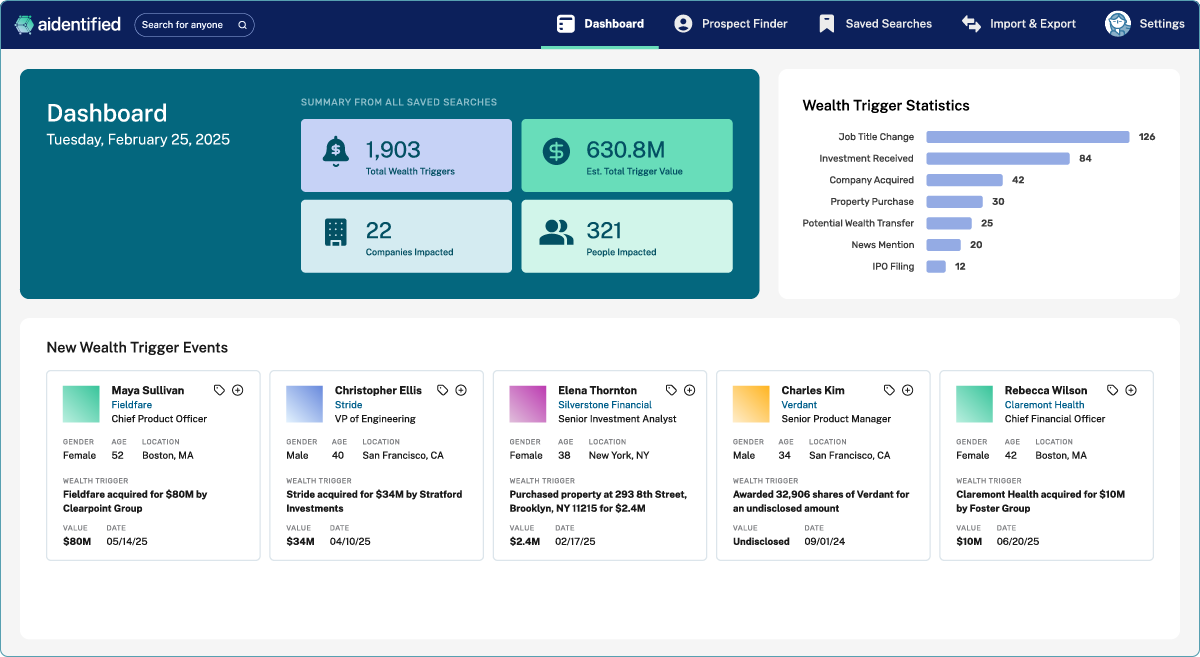
- Automated Wealth and Loyalty Screening Integrations: Software capabilities that scan donor interaction records, flag consecutive annual givers, and score constituents based on legacy propensity markers rather than gross income alone.
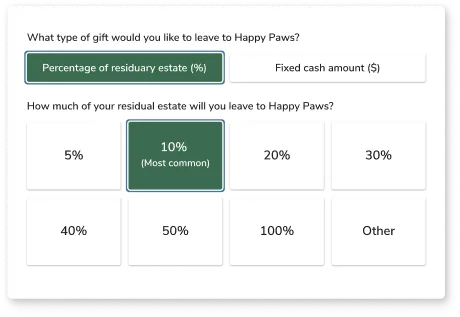
- Donor-Facing Bequest and Estate Portals: Custom-branded digital portals that provide donors with free estate planning tools, simple bequest-wording generators, and direct beneficiary-designation forms.
- Interactive Gift Illustration Calculators: Self-service digital calculators that allow donors and their financial advisors to model Charitable Gift Annuities (CGAs), Charitable Remainder Trusts (CRTs), and IRA Qualified Charitable Distributions (QCDs).
- CRM Data Synchronization and Activity Logging: Bi-directional API integrations that automatically map bequest intentions, guide downloads, and calculator interactions back to central donor management platforms.
- Automated Stewardship and Legacy Society Workflows: Automated email triggers and task generation that ensure immediate executive touchpoints whenever a donor downloads a bequest kit or indicates a legacy preference.
Deploying software equipped with these feature sets transforms static websites into active conversion engines. Streamlining the donor experience through self-service digital tools enables gift officers to enter donor conversations at the execution phase rather than spending months on cold discovery calls.
Driving Pipeline Growth with Consultant Partnerships
Achieving maximum donor lifetime value requires connecting every stage of the fundraising funnel into a unified conversion engine. Executive leadership must combine current-use wealth capture with long-term estate capture. Deploying automated software alongside a personalized, high-converting strategy creates an unstoppable revenue system that maximizes donor value across their entire life cycle.
And one of the best ways to set your planned giving campaign up for success is to work with a professional fundraising advisor! These consultants can partner with your organization to help your team analyze legacy giving capacity, build structured donor pipelines, and design compliant planned giving programs for organizations that lack internal expertise.
A well-integrated, thoroughly planned approach to legacy giving ensures your organization never leaves money on the table. This builds a modern development operation that extracts maximum ROI from every constituent in your database.
Wrapping Up & Next Steps for Nonprofits
Maximizing donor lifetime value is not a luxury for nonprofit institutions; it is an executive mandate for long-term survival. Implementing a dedicated planned giving tool enables development leadership to systematically convert loyal annual givers into multi-generational endowment builders, scaling overall LTV and securing permanent institutional resilience.
To execute this financial strategy and upgrade your technological infrastructure, board leadership and executive directors should complete these core actions:
- Run an LTV and pipeline loss calculation across your donor base to quantify uncaptured estate wealth among loyal supporters.
- Audit your current software stack to ensure you possess the best planned giving tools, bequest calculators, and estate planning portals.
- Deploy matching gift technology to maximize current cash flow while generating high-propensity signals for your legacy pipeline.
- Integrate planned giving data streams into your CRM to automate stewardship workflows and alert gift officers to digital inquiries.
These proactive steps replace unpredictable annual fundraising cycles with a scalable, automated wealth-capture pipeline that ensures institutional strength for generations to come.
For more information, check out Double the Donation’s guide to planned giving basics!


