How To Use Tech to Support Your Corporate Volunteer Strategy

How To Use Tech to Support Your Corporate Volunteer Strategy

Modern professionals demand more than just a paycheck; they require purpose. They view their employer’s CSR benefits (such as Volunteer Grants and Volunteer Time Off) as essential parts of their compensation packages. As a result, today’s employees have the freedom to choose the causes that resonate with them personally.

This presents a massive opportunity, but also a logistical challenge for nonprofits and CSR leaders alike. When thousands of employees are empowered to volunteer at thousands of different organizations, how do you track your impact? How do you ensure utilization of benefits? And, most importantly, how do charitable organizations capture the revenue associated with these hours?

The answer lies in technology.

To thrive in this new environment, organizations must leverage the right tools to uncover corporate volunteer opportunities, streamline validation processes, and bridge the gap between employee intent and corporate impact. And the result? The monetization of volunteer efforts in a new and powerful way.

The Era of Employee Choice: Why It Matters

Before diving into the technology, it is vital to understand the “why” behind this strategy. The decentralization of corporate volunteering is driven by a desire for autonomy.

An employee in the accounting department might be passionate about animal welfare, while a developer in IT cares deeply about STEM education for underrepresented youth. If a corporation forces both to volunteer at a food bank, engagement drops. However, when companies offer “open” volunteer grant programs (in which the company donates money for every hour an employee volunteers at any eligible 501(c)(3)), participation skyrockets.

The Implications for Nonprofits:

This freedom of choice means nonprofits are no longer just pitching to a corporate CSR manager. Rather, they are pitching corporate volunteer recruitment to every single individual employee. You are competing for their time and the grant dollars associated with it.

  • The Benefit: You have access to a much wider pool of potential corporate funds without needing a formal partnership with the headquarters.
  • The Challenge: You need a way to identify which of your existing volunteers have these benefits and remind them to use them.

This is where technology stops being a luxury and starts being a necessity. You cannot manually survey every volunteer about their benefits package, especially within a large organization. For this reason, you’re going to need a tech-enabled strategy to identify, capture, and monetize this decentralized volunteerism.

Uncovering Hidden Revenue with Smart Tech Integration

The primary reason corporate volunteer strategies fail to generate revenue is a lack of awareness, not a lack of generosity.

Research consistently shows that while over 40% of Fortune 500 companies offer volunteer grant programs, participation rates remain low overall. Why? The employee often doesn’t realize the program exists or forgets to log their hours in their company’s portal.

To support a robust corporate volunteer strategy, nonprofits must integrate volunteer technology that serves as a “detective,” automatically uncovering these hidden opportunities.

1. The Power of “Just-in-Time” Discovery

Your volunteer intake forms and event registration pages are the front lines of your strategy. By integrating a volunteer grant search tool directly into these digital touchpoints, you capture the right data when intent is highest.

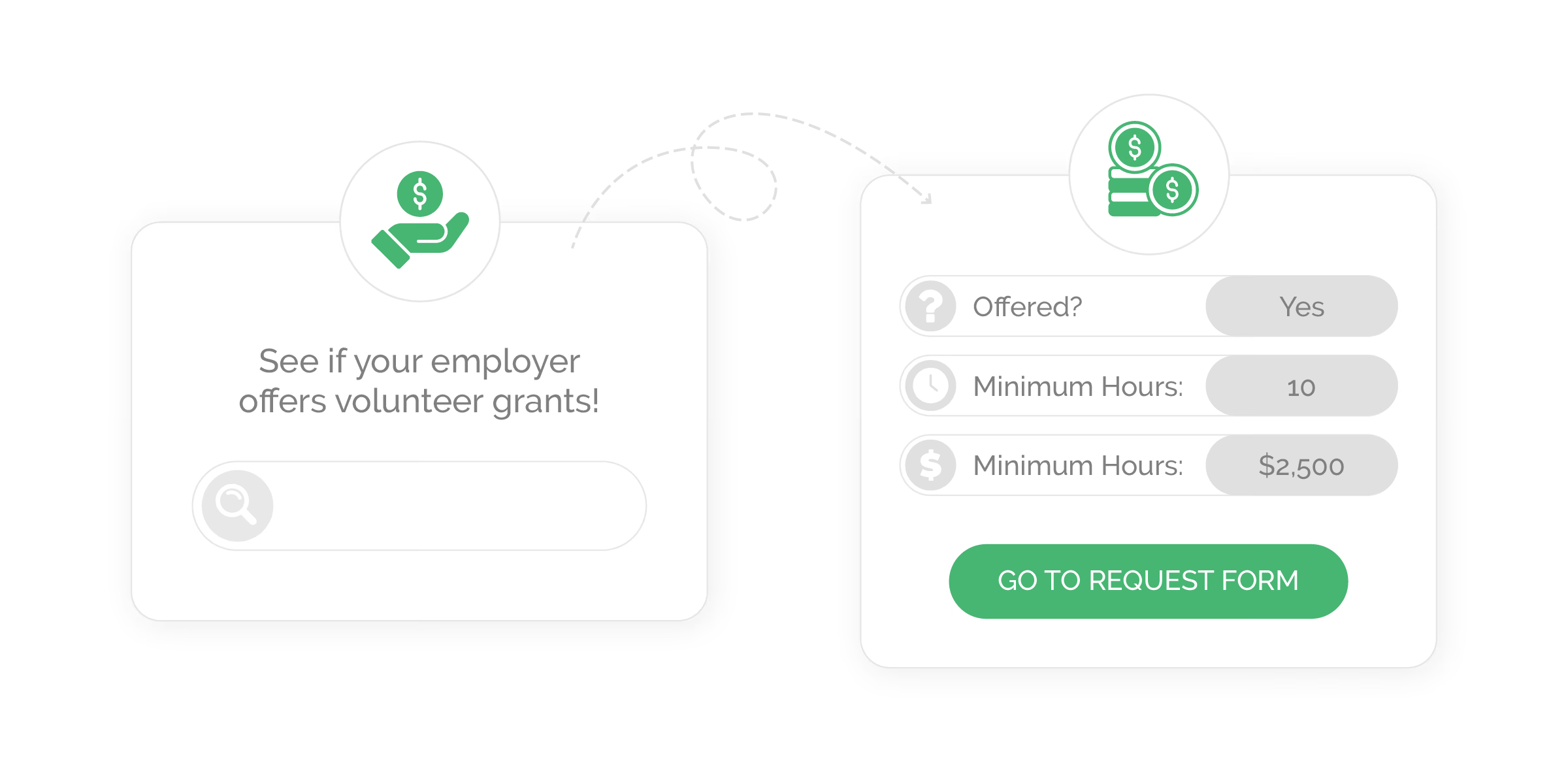
Imagine a volunteer signing up for a Saturday shift. As they type their employer’s name (e.g., “Microsoft”) into a search widget on your registration form, the technology immediately flags that Microsoft pays $25 per volunteer hour.

  • Without Tech: The volunteer shows up, works, and leaves. The nonprofit gets the labor but misses the funds.
  • With Tech: The volunteer is presented with a pop-up or auto-email explaining that their 4-hour shift is worth $100 to the organization. From there, they receive a direct link to the Microsoft submission portal, along with instructions for completing the simple steps.

This immediacy is crucial. By using tech tools to present information to the volunteer beforeduring, or soon after their engagement, you drastically increase the likelihood of a successful grant submission.

2. Employer Appends and Data Enrichment

Many organizations sit on a goldmine of volunteer data that lacks context. You may have a list of 5,000 past volunteers, but if you don’t know where they work, you can’t monetize their time.

Modern data services, often called “employer appends,” use technology to scan your existing database and match email addresses or names with up-to-date employment information. This allows you to segment your audience, such as identifying a cluster of 50 volunteers who all work for Home Depot.

With this insight, you can launch a targeted digital campaign: “Did you know Home Depot offers a volunteer grant program? Your collective 200 hours of service last year could translate into more than $5,000 for our cause. Here is the link to submit.”

This turns a simple “thank you” email into a revenue-generating activation.

Leveraging Volunteer Time Off (VTO) Benefits

One of the most underutilized assets in the corporate sector is Volunteer Time Off (also known as VTO). This is distinct from a volunteer grant; VTO is essentially paid time off granted by the company specifically for volunteer work.

In a competitive labor market, companies are expanding VTO policies to attract talent. However, many employees hesitate to use it because they don’t know how to schedule it or feel guilty stepping away from their desks.

How Tech Supports VTO Strategy

To help bridge the Volunteer Time Off gap, your technology needs to act as a proactive planner. By integrating Double the Donation Volunteering’s tools, you can automate the discovery and reminder process, turning a passive benefit into confirmed attendance.

Here’s how:

  • Data Capture at Registration: The most critical step in leveraging VTO is identifying eligibility the moment a volunteer expresses interest. Luckily, Double the Donation’s tools integrate directly into your existing volunteer registration forms. As a user signs up for a shift, they can search for their employer using the embedded widget. This immediately captures their employment data and flags whether their company offers a VTO policy, removing the guesswork for your team.
  • Pre-Event Automated Outreach: Once employment information is captured, timing is everything. Instead of waiting until after the service is complete, the software allows you to automate outreach before the scheduled shift. If a volunteer is identified as working for a company with a VTO program, the system can trigger a personalized email encouraging them to secure approval from their manager or HR department ahead of time.

By making it technologically seamless to identify VTO eligibility and remind volunteers to use it, nonprofits can significantly increase volunteer attendance during standard business hours and other hard-t0-fill shifts.

The “Dollars for Doers” Ecosystem

To truly support a corporate volunteer strategy, one must understand the financial mechanics of “Dollars for Doers” or volunteer grants.

The data is compelling. 80% of companies with these programs offer between $8 and $15 per hour, while some go significantly higher. For a nonprofit, this means that a solid volunteer strategy is actually a donor acquisition strategy.

The Tech-Enabled Workflow

And, of course, the right technology can go a long way. Here’s how equipping your volunteer engagement team with the proper tools will help power your corporate volunteer strategy and diversify your nonprofit revenue:

  1. Identification: A volunteer registers online. The Double the Donation widget identifies the individual as “Volunteer Grant Eligible.”
  2. Automation: 24 hours after the shift, your fundraising software triggers an automated email.
    • Subject: You made a difference + You can double it!
    • Body: “Thank you for volunteering 5 hours for our cause. Because you work for [Company Name], those hours are eligible for a $100 grant. Click here to submit your request in less than 2 minutes.”
  3. Tracking: The software tracks the “open” opportunity until the funds are received, allowing the nonprofit to report on “Volunteer Generated Revenue.”

This workflow removes the burden from the nonprofit volunteer coordinator, who is likely already stretched thin. It puts the process on autopilot, ensuring that as long as volunteers show up, revenue requests are generated.

Making the Case to Corporate Partners

While current trends increasingly favor employee choice, direct corporate partnerships still exist. However, the expectations have changed.

Corporate CSR leaders are increasingly data-driven. These teams need to justify their budgets to their C-suites. When a corporation considers partnering with a nonprofit, they want to know: “Can you handle our people, and can you effectively report on their impact?”

Technology allows you to say “Yes” with confidence. Here’s how:

  • Leverage Data to Pitch Formal Partnerships: Rather than cold-calling, use your Double the Donation dashboard to identify which corporations are already represented in your volunteer base. Approaching a CSR director with the insight that “50 of your employees already volunteer with us” transforms a cold pitch into a warm, data-backed conversation about formalizing a group event or sponsorship.
  • Branded Landing Pages: You can quickly spin up a registration page specifically for “Bank of America Volunteers” using your dedicated volunteer management software.
  • Real-Time Impact Dashboards: Instead of sending a static spreadsheet a few months post-event, provide corporate partners with digital dashboards that show the total hours volunteered, the number of employees engaged, and the monetary value of that time.

By demonstrating that you have the tech stack to support their engagement strategy, your organization becomes a lower-risk, higher-value partner for major corporations and other impact-focused businesses.

Case Studies in Tech-Enabled Corporate Volunteerism

Success in this arena isn’t theoretical. Leading organizations are already using these digital strategies to uncover opportunities and drive revenue.

Let’s check out a few powerful examples!

1. The “Education Hub” Approach (Long Island Cares)

Long Island Cares recognized that their volunteers wanted to help but didn’t know the rules. Therefore, they decided to use their website as an education hub. By embedding a search tool directly under their main navigation, they made “Check your eligibility” a core part of the volunteer journey.
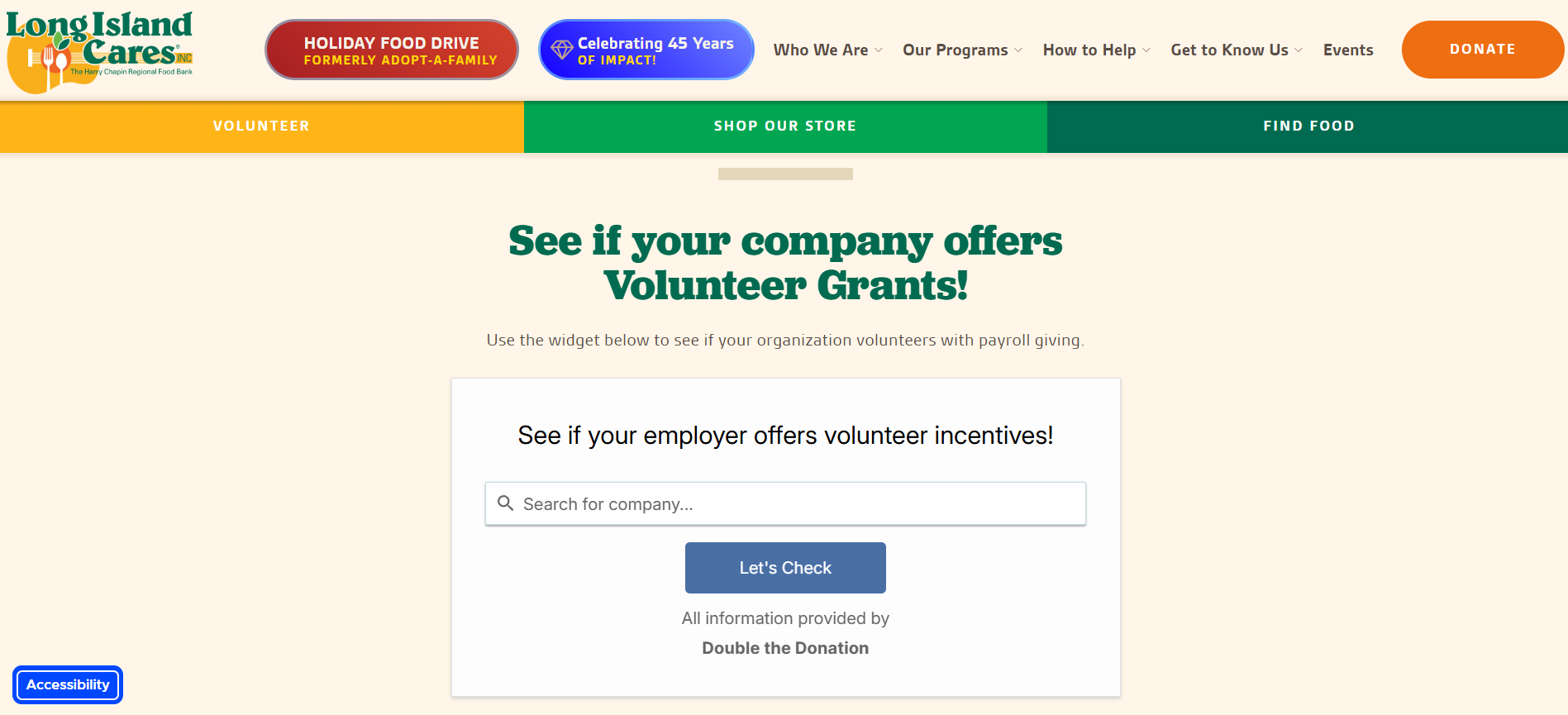
A look at Long Island Cares' corporate volunteer strategy

The Tech Win: They didn’t bury the information in a PDF; they made it interactive and searchable, capturing intent (and opportunity) instantly.

Explore more of Long Island Cares’ corporate volunteer strategy here.

2. Quantifying Value (Veterans Community Project)

Veterans Community Project does an incredible job of using its data to tell a compelling story. The organization explicitly states the monetary value of its volunteers on its impact pages (totaling more than $827,000 in a single year).
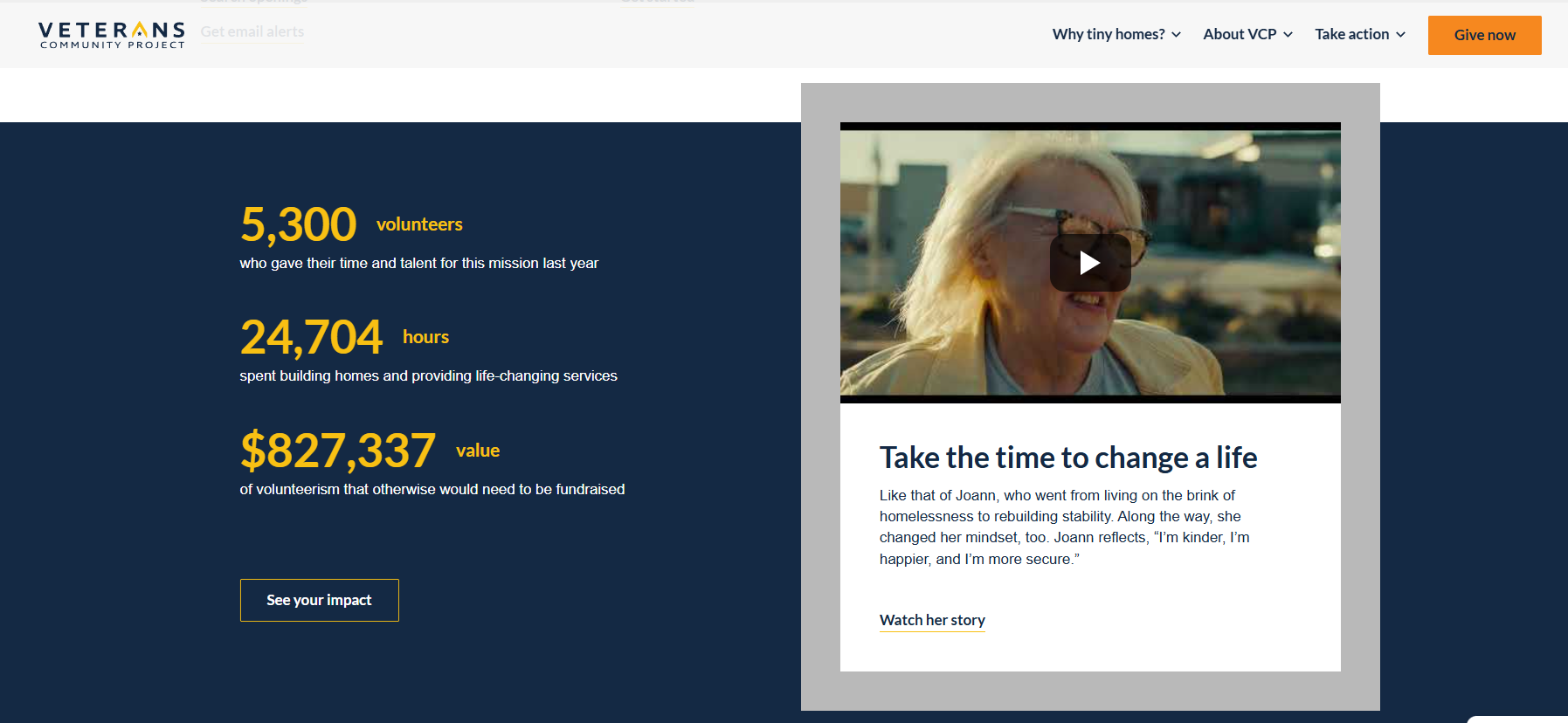
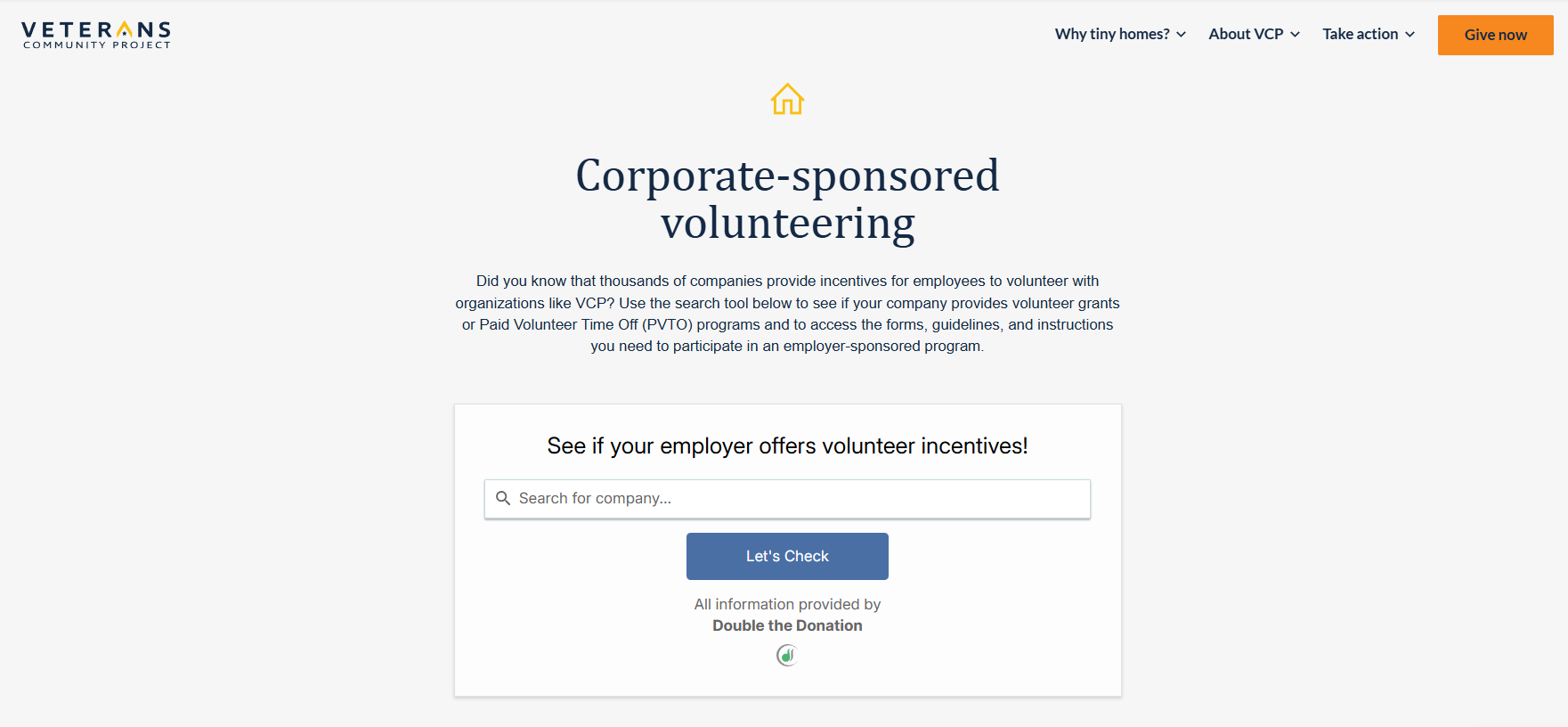
A look at Veterans Community Project's corporate volunteer strategy

A look at Veterans Community Project's corporate volunteer strategy

The Tech Win: By tracking hours digitally and assigning a tangible dollar value to them, they prime the pump. When they ask a volunteer to submit a grant request, the volunteer already understands that their time has financial worth. They also use their site to educate employees about Paid Volunteer Time Off (PVTO), giving them the green light to skip work for a good cause.

Explore more of Veterans Community Project’s corporate volunteer strategy here.

3. Removing Friction (Carolina Tiger Rescue)

The biggest enemy of volunteer grants is friction in the process. If a volunteer has to hunt for a Tax ID, a mailing address, or a contact email, they will likely abandon the submission altogether. Luckily, Carolina Tiger Rescue counters this obstacle by placing all necessary legal and contact data right next to the actionable search tool.
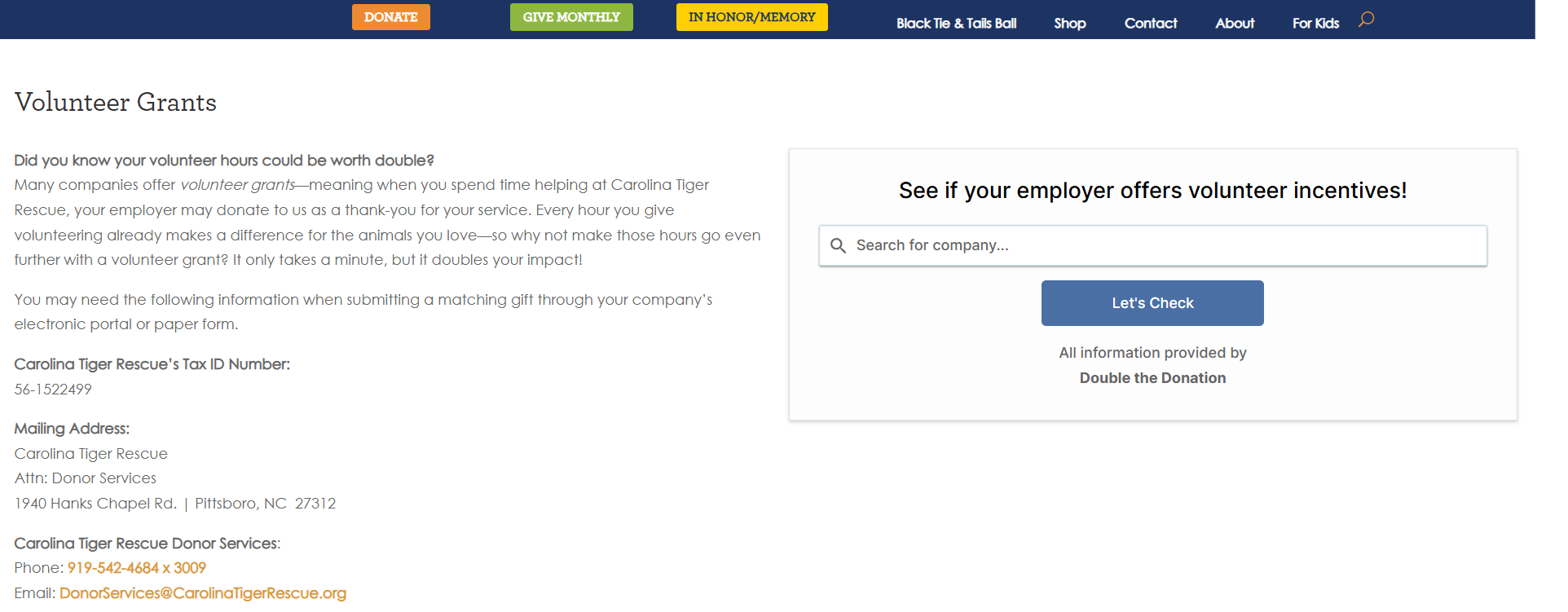
A look at Carolina Tiger Rescue's corporate volunteer strategy

The Tech Win: This organization fully anticipates the user’s needs. The technology provides the “eligibility” answer, and the static content provides the “submission” details. It’s a seamless handoff with great results.

Explore more of Long Island Cares’ corporate volunteer strategy here.

5 Steps to Implement a Tech-Forward Volunteer Strategy

If you are ready to pivot from a passive volunteer program to an active, revenue-generating strategy, follow this step-by-step roadmap:

Step 1: Audit Your Digital Intake.

Review your volunteer registration forms, waivers, and event sign-ups. If you’re not asking for employer information (or better yet, providing a search tool to validate it), you are essentially flying blind. Add the field immediately to kick things off.

Step 2: Automate the Ask.

Do not rely on your volunteer coordinator to remember to ask for volunteer grants. Instead, implement an automated email sequence that triggers after a volunteer completes a shift. The message should be simple: “Did you know your time is worth money? Here is how you can submit.”

Step 3: Promote “Total Giving.”

Update your website copy to reflect the modern corporate benefits package. Use language like “Maximize your Employee Benefits” or “Use your VTO here.” Frame volunteering not just as “helping our cause,” but as “utilizing the perks you earned at work.”

Step 4: Segment Your Communications.

Stop sending generic emails. Use your tech tools to segment volunteers by employer. Send a targeted blast to all employees of a major bank in your area, or those who work for a certain corporate giant, highlighting their specific grant programs.

Personalized communication drives higher conversion.

Step 5: Report and Refine.

Use your dashboard to see which companies are searching for you. If you see 100 searches from “Target” employees but zero grants are actually completed, you know you have a submission bottleneck. If you see high search volume from a specific business, reach out to their local CSR office to formalize a partnership, letting the data dictate your outreach.


Conclusion

The corporate volunteer landscape has evolved. It is more democratic, more flexible, and more potential-rich than ever before. But with that freedom comes fragmentation.

Nonprofits can no longer wait for a centralized directive from a corporate headquarters to send funding their way. They must empower the individual employee to act. By leveraging innovative technology to identify eligibility, educate supporters, and automate the submission process, you can transform your volunteer program from a simple labor source into a sustainable, diversified revenue stream.

The employees have the freedom to choose where they give their time. Use technology to make sure they choose you, and that they bring their corporate dollars with them.

Ready to get started? Reach out to Double the Donation to learn more about how their industry-leading software can help power your corporate volunteer strategy.
Unlock Revenue Top Corporate Volunteer Platforms to Note

Unlock Revenue: Top 12 Corporate Volunteer Platforms to Note

Engaging corporate volunteers does far more than supply labor for a single project; it can be a critical strategy for unlocked revenue and sustainable growth. But you need the right corporate volunteer platforms to power your efforts!

Employees contribute their time and professional skills, and with more companies than ever offering volunteer grants (Dollars for Doers) and volunteer time off (VTO) programs, corporate volunteers can present nonprofits with a valuable opportunity for volunteer recruitment and revenue generation.

By leveraging a modern VMS that seamlessly connects a volunteer’s activity to their employer’s giving program, you instantly amplify the value of every hour. This strategic approach converts corporate engagement from a one-time service event into a predictable, multi-layered source of funding and stronger corporate partnerships. Here’s what you should know.

Engaging Corporate Volunteers: What Platform Features Generate Success

Let’s take a look at some of the criteria we evaluated in determining the best platforms for engaging corporate volunteers.

1. Seamless workplace giving program identification

One of the most effective ways to increase the ROI of a volunteer program is through corporate volunteer grants, often called “Dollars for Doers.” For this reason, we prioritized platforms that integrate natively with workplace giving technology, such as Double the Donation Volunteering.

Seamless workplace giving integrations allow your system to automatically identify which volunteers work for companies with matching grant programs. By capturing employment data during sign-up and triggering automated follow-ups, these platforms ensure that no corporate revenue is left on the table. While company volunteer days are a salient form of corporate volunteerism, ensuring that individual volunteers can take advantage of their company’s volunteering programs, such as Dollars for Doers, is equally important.

2. Group Signups and Private Reservations

Corporate partners usually need to reserve specific time blocks exclusively for their employees. Therefore, we looked for software that offers dedicated group management tools or private event links suitable for corporate volunteer days. These features allow a corporate coordinator to manage their own team’s sign-ups without needing full administrative access to your nonprofit’s system.

Some top tools even provide “join codes” or custom-branded landing pages, making the registration process feel like a professional, seamless extension of the company’s own brand. As more companies leverage volunteerism to engage employees, tools like these make for a smoother experience.

3. Accurate Reporting and Hour Tracking

Data accuracy is helpful for corporate partners looking to verify service hours for their internal CSR reports. To make it easy, we assessed platforms based on their ability to provide real-time, verifiable tracking through mobile apps, geo-fencing, or on-site kiosks.

4. Integrated Communication Tools

Maintaining long-term relationships with professional volunteers requires timely and professional communication strategies. We favored systems with robust, built-in communication suites that include automated shift reminders, SMS capabilities, and post-event thank-you notes.

Systems that allow segmented messaging to email only volunteers from a specific company are particularly valuable for delivering the “white-glove” experience that corporate partners are coming to expect.

Our Top-Recommended Workplace Giving Identification Tool

Double the Donation Volunteering tackles a unique part of the corporate volunteer engagement process. With this dedicated fundraising platform, nonprofits and volunteers can research employer volunteer incentive programs and discover supporters’ eligibility for volunteer time off and volunteer grant opportunities in seconds.

Double the Donation maintains a comprehensive corporate giving database that helps organizations:

  • Maximize corporate volunteer engagement and participation by enabling supporters to easily uncover ways to increase support.
  • Proactively and effectively market corporate volunteer incentives to individual supporters without having to do manual research.
  • Increase volunteer program success by identifying high-value opportunities and staying on top of relevant industry trends.
  • Equip their teams with the knowledge and resources they need to effectively tap into volunteer incentives.

Power your corporate volunteer platforms with the Double the Donation Volunteering integration.

All in all, this standout tool draws on the industry’s most comprehensive source of information on corporate volunteer incentives, such as volunteer grants and VTO, making it easier than ever for volunteers to access program details and get involved. Plus, it integrates seamlessly with many of the leading volunteer management platforms we cover below.

Top 12 VMS Platforms for Engaging Corporate Volunteers

Effective corporate engagement requires a comprehensive platform that can handle the complexity of professional groups and help individual volunteers extend their impact through their company’s volunteer programs. We’ve compiled some of the top systems bridging the gap between nonprofit needs and corporate goals.

is one of the leading corporate volunteer platforms.

Better Impact

Standout corporate volunteer platform features include:

  • Flexible Scheduling: Volunteers can save their favorite shifts, so volunteer managers know typical availability and preferred roles. Flexible and self-scheduling options are particularly helpful for volunteers balancing service with professional obligations.
  • Marketing Data Collection: By tracking open, click-through, response, and conversion rates from emails and text messages, nonprofits can easily identify engagement opportunities and improve retention. These features can help organizations turn one-time company volunteers into long-term champions by identifying volunteers eager to return.
  • Advanced Compliance Tools: Built-in tools for training, credential tracking, and digital waiver management ensure that every corporate volunteer has completed the necessary steps for safe service.

Explore Better Impact’s VMS software here to learn more.

Bugle is one of the leading corporate volunteer platforms.

Bugle

Standout corporate volunteer platform features include:

  • Group Reservation Functionality: A volunteer can reserve a block of spots for their entire corporate group, and the system provides a unique URL that group members use to claim their specific roles.
  • Impact Update Reports: After an event, organizations can quickly send automated “Impact Updates” with photos and outcomes to the volunteers, ensuring corporate partners and individual volunteers alike feel appreciated and see their impact.
  • Double the Donation Integration: Volunteers can add their company name while signing up for shifts and immediately view volunteer grants and volunteer time off hours provided by their employer.

Explore Bugle’s VMS software here to learn more.

Get Connected is one of the leading corporate volunteer platforms.

Get Connected by Galaxy Digital

Standout corporate volunteer platform features include:

  • Direct Connections with Companies: Get Connected’s Volunteer Link product gives corporate leaders access to over 200,000 volunteer opportunities with the nonprofits using Get Connected volunteer management software, making nonprofit-corporate partnerships seamless.
  • Corporate Partnership Tools: Organizations can take advantage of custom landing pages, automated communication tools, and real-time employee impact tracking for easy sharing with corporate partners.
  • Groups & Teams: Streamlined group and team management tools make facilitating projects with corporate groups straightforward.

Explore Get Connected by Galaxy Digital’s VMS software here to learn more.

Golden is one of the leading corporate volunteer platforms.

Golden

Standout corporate volunteer platform features include:

  • Custom Reservations and Claiming: Nonprofits can designate specific shift blocks as Custom Reservations for corporate teams, which companies can then claim through a professional, frictionless interface.
  • Targeted Volunteer Matching: The intelligent matching system ensures the right opportunities reach the right volunteers, particularly helpful for organizations looking to recruit volunteers with particular professional backgrounds or skillsets.
  • AI-Powered Donor Conversion: Golden’s AI fundraising tools can help guide corporate volunteers to becoming long-term financial contributors, effectively bridging the gap between time and money.

Explore Golden’s VMS software here to learn more.

MissionTracker is one of the leading corporate volunteer platforms.

MissionTracker

Standout corporate volunteer platform features include:

  • Group Time Clock: The platform includes a digital time clock that simplifies the check-in process for large corporate groups, ensuring that every hour is accurately captured and verifiable for grant reporting.
  • Customizable Applications: Organizations can create multiple volunteer applications, suited for both individual applications and groups. Custom data points and waivers account for projects and roles with different needs.
  • Double the Donation Integration: MissionTracker natively integrates with Double the Donation Volunteering, so volunteers can provide their employer and connect to workplace giving opportunities at signup.

Explore MissionTracker’s VMS software here to learn more.

PlanHero is one of the leading corporate volunteer platforms.

PlanHero

Standout corporate volunteer platform features include:

  • Time Spots for Hours Tracking: Volunteers can easily self-report hours through Time Spots. With admin verification available, these time logs provide the data required for successful corporate volunteer grant applications.
  • Modern and Mobile-Friendly UI: The simple, clean design ensures that busy professionals can sign up for events from any device without the need to create a complex account or download a new app.
  • Double the Donation Integration: PlanHero’s live integration prompts volunteers to supply their employment information post-registration, helping identify those eligible for paid volunteer time off and volunteer grants.

Explore PlanHero’s VMS software here to learn more.

POINT is one of the leading corporate volunteer platforms.

POINT

Standout corporate volunteer platform features include:

  • POINT for Companies: POINT’s platform for for-profits includes a dedicated business dashboard that corporate partners use to manage their own volunteer programs and track their employees’ total impact.
  • Co-Hosting Collaboration: Nonprofits can use co-hosting features to work directly with businesses on joint events, allowing both parties to view registration data and share credit for the outcomes.
  • Network Feature: With Networks, organizations can join together for easy collaboration, improved project tracking, and cross-organization communication – great for national corporations, city governments, volunteer centers, and large nonprofits.

Explore POINT’s VMS software here to learn more.

Summa is one of the leading corporate volunteer platforms.

Summa

Standout corporate volunteer platform features include:

  • Integrated Fundraising and Volunteer Data: The platform combines donor profiles with volunteer records, making it easier to identify corporate volunteers who have the potential to become major financial supporters.
  • Targeted Outreach Segmentation: Organizations can use the platform’s robust segmentation tools to send personalized communication and reports to volunteers from specific corporate partners based on their activity history.
  • Double the Donation Integration: By embedding employer search tools directly into signup forms, Summa identifies corporate grant eligibility early in the volunteer lifecycle to maximize matching revenue. Plus, Double the Donation also integrates with Summa’s fundraising tools to identify donation matching opportunities.

Explore Summa’s VMS software here to learn more.

Timecounts is one of the leading corporate volunteer platforms.

Timecounts

Standout corporate volunteer platform features include:

  • Database Tags & Custom Fields: Custom database fields allow nonprofits to collect exactly the information they need from their corporate volunteers. Tags offer an easy way to group and organize volunteers within the database.
  • Team Inbox and Messaging: A shared team inbox allows for streamlined communication with corporate coordinators, ensuring that logistics and follow-ups are managed efficiently, and partnership opportunities don’t fall through the cracks.
  • Double the Donation Integration: The Form Builder tool integrates with Double the Donation, so organizations can seamlessly capture volunteer employment information on their volunteer forms.

Explore Timecounts’ VMS software here to learn more.

VolunteerHub is one of the leading corporate volunteer platforms.

VolunteerHub

Standout corporate volunteer platform features include:

  • Fundraising Tools: Many employee volunteers are also eligible for donation matching opportunities through their employers. With automatic donation asks, organizations can convert volunteers to financial supporters.
  • Branded Landing Pages: Organizations can create unlimited, custom-branded landing pages for specific corporate partners, providing a white-label experience that aligns with the company’s branding.
  • Skills-Based Segmentation: With the ability to email, text, report on, and reserve events for users with a common interest or skill, VolunteerHub makes engaging skilled volunteers seamless.

Explore VolunteerHub’s VMS software here to learn more.

VolunteerMatters is one of the leading corporate volunteer platforms.

VolunteerMatters

Standout corporate volunteer platform features include:

  • Invitation-Only Projects and Events: Administrators can designate project and event pages as “by invitation only” to keep them hidden from public view, perfect for company-specific events.
  • Custom Landing Pages for Sponsors: Designed to deepen corporate partnerships, organizations can create landing pages specifically for certain sponsors, complete with their own logo. Corporate sponsors can even be given access to manage their own pages.
  • Double the Donation Integration: An integrated company search tool allows volunteers to discover their employer’s grant eligibility directly within the VolunteerMatters platform.

Explore VolunteerMatters’ VMS software here to learn more.

Vome is one of the leading corporate volunteer platforms.

Vome Volunteer

Standout corporate volunteer platform features include:

  • Detailed impact reporting: Users can assign a specific impact value to volunteers based on their skills, expertise, and task assignment, making for more accurate reporting on the impact of corporate volunteer engagement.
  • Robust Analytics & Reports: The platform provides detailed reports and analytics on volunteer activities, helpful for measuring the success of corporate volunteer efforts.
  • Double the Donation Integration: A seamless integration with Double the Donation allows all volunteers to identify their company’s Dollars for Doers opportunities directly during the sign-up process, ensuring no corporate revenue is missed.

Explore Vome Volunteer’s VMS software here to learn more.


Next Steps: Turning Corporate Service into Sustainable Revenue

Corporate volunteerism represents one of the most significant untapped resources for modern nonprofits. As we’ve seen, the difference between a one-off service day and a sustainable, revenue-generating partnership often comes down to the technology you use. By selecting a Volunteer Management System that prioritizes group logistics, seamless communication, and (crucially) workplace giving integration, you position your organization to capture the full value of every hour served.

The right tools do more than just simplify scheduling; they bridge the gap between human capital and financial growth. When you make it effortless for volunteers to leverage their company’s Dollars for Doers and VTO programs, you transform a simple shift into a powerful engine for funding and long-term advocacy.

Ready to unlock the full potential of your corporate partnerships? Take the next step in professionalizing your corporate engagement strategy. Explore Double the Donation Volunteering today to see how seamless integration can help you identify eligible supporters, increase revenue, and turn corporate teams into lifelong champions for your cause.

Nonprofit Revenue Diversification 5 Sustainable Funding Streams

Nonprofit Revenue Diversification: 5 Sustainable Funding Streams

In the current economic landscape, relying on a single source of funding is a risky strategy for any charitable organization. Market fluctuations, shifting donor priorities, and changes in government policy can suddenly destabilize even the most established nonprofits. If 80% of your funding comes from one annual gala or a specific government grant, your mission is vulnerable. To build long-term resilience, forward-thinking leaders must actively pursue nonprofit revenue diversification.

Revenue diversification is not just about receiving more money; it is about finding different kinds of money. By cultivating multiple distinct income streams, your organization can smooth out financial peaks and valleys, ensuring it has the resources to fulfill its mission regardless of external conditions. A diverse portfolio reduces risk and allows you to plan for the future with confidence rather than fear.

In this comprehensive guide, we’ll cover:

Let’s explore how you can implement these strategies to build a more robust financial future for your organization.

The Strategic Value of Revenue Diversification

Many nonprofit leaders view revenue diversification as a luxury, or something to tackle “when we have time.” However, it is actually a fundamental component of risk management. A diversified revenue model creates a safety net. If individual giving drops during a recession, revenue from corporate contracts or foundation grants can sustain operations. If a major grant expires, recurring monthly donors provide a baseline of support.

Beyond financial stability, diversification often opens doors to new networks and audiences. Engaging with corporations for grants introduces you to their employees who are willing to volunteer. Launching a challenge match engages major donors while simultaneously motivating smaller, individual givers. It is a holistic approach that strengthens your entire fundraising ecosystem.

Furthermore, different revenue streams come with different restrictions. Grants are often restricted to specific projects, while individual donations are frequently unrestricted. By balancing these sources, you ensure you have the cash flow to cover overhead costs like rent and salaries, which are often harder to fund solely through grants.

Workplace (or Employee-Led) Giving Programs to Note

Workplace giving is one of the most efficient ways to build a sustainable revenue pipeline. These programs allow employees to support nonprofits through their employers, often with the help of automated platforms. Because these funds often come from corporate budgets or payroll deductions, workplace giving programs provide a reliable layer of support that complements individual giving.

Unlike a one-time event, workplace giving builds long-term relationships among donors, employers, and your nonprofit.

Corporate Matching Gifts

Matching gifts are often considered the cornerstone of workplace giving and represent one of the largest untapped sources of revenue for nonprofits. In these programs, companies match their employees’ donations to eligible nonprofits with cash. This effectively doubles the impact of a single donation without requiring the donor to give more from their own pocket.

Despite their value, these funds are often underutilized due to a lack of awareness. Donors simply do not know their employer offers the program, or they find the process too cumbersome. However, the potential impact is massive. According to Double the Donation’s matching gift statistics, 84% of donors say they are more likely to donate if a match is offered, and 1 in 3 say they would give a larger gift if a match is applied.

To capture this revenue, organizations must move beyond passive hope. Integrating a fundraising tool that identifies match-eligible donors during the donation process is critical. When a donor sees a prompt like, “See if your company will match this gift,” they are reminded of the opportunity at the moment of peak engagement.

Did You Know?

An estimated $4 to $7 billion in matching gift revenue goes unclaimed every year. This isn’t because companies don’t want to give; it is because donors don’t submit the paperwork. Using a matching gift database can help you automatically identify these prime opportunities.

Employee Volunteer Grants

Time is money, especially when volunteer grants are involved. Also known as “Dollars for Doers,” these workplace giving programs incentivize volunteerism by awarding monetary grants to nonprofits where employees volunteer. For example, a company might donate $500 to a nonprofit after an employee logs 20 hours of service. This turns your volunteer program into a revenue-generating asset with ease.

These grants are particularly valuable because they honor the commitment of your most dedicated supporters: those who give their time. Companies like Verizon, Microsoft, and Google all have robust volunteer grant programs. To capitalize on this, ensure your volunteer coordinators ask volunteers about their employers during onboarding and registration, and educate them on how to submit their grant requests. You should also track volunteer hours meticulously, as companies will likely require verification before releasing funds.

Automated Payroll Giving

Payroll giving allows employees to donate a portion of their regular paychecks directly to a nonprofit. Because these donations are often deducted pre-tax, it lowers the donor’s taxable income while providing your organization with a steady, predictable stream of unrestricted revenue. It is a “set it and forget it” method that encourages long-term engagement.

This method of giving boasts incredibly high donor retention rates because donations occur automatically. The donor does not have to remember to write a check or enter their credit card information every month. To grow this stream, ask your corporate partners to include your nonprofit on their annual giving campaign list. Being a featured charity during a company’s “giving season” can lead to a significant influx of new and recurring donors.

Corporate Grants for Nonprofits

While workplace giving engages individual employees, corporate grants come directly from a company’s philanthropic budget or foundation. These contributions are typically awarded to organizations that align with the company’s values or corporate social responsibility (CSR) goals. Unlike government grants, which can be overly bureaucratic and slow, corporate grants often have more flexible application processes and faster turnaround times.

There are generally two types of corporate giving buckets to look for: corporate foundations and marketing/community relations. Foundations usually have strict guidelines and grant cycles, whereas community relations budgets can be more discretionary and used for local sponsorships or immediate community needs.

How to Secure Corporate Grants

Securing a corporate grant requires thorough research and alignment with the mission. For the best results, you must demonstrate how your cause supports the company’s own objectives. Does a business focus on STEM education? Environmental sustainability? Hunger relief? Your proposal should speak their language.

To get started, take a look at businesses in your local community or companies that have a history of giving to your cause. Review their CSR reports to understand their funding priorities. Once you identify a prospect, tailor your proposal to highlight mutual benefits. Show them exactly how their funding will create a tangible impact that they can share with their stakeholders to make a difference.

Additionally, you can also look for companies that offer “in-kind” or non-monetary support. In-kind donations for nonprofits (such as donated technology, office space, or professional services) can significantly reduce your operating costs, freeing up cash for other programs. For example, a local law firm might offer pro bono legal services, or a tech company might donate refurbished laptops for your staff. Then, the money you would have spent can go directly to your mission recipients.

Quick Tip

Don’t just look at the “Big Three” corporations in your city. Mid-sized local businesses often receive fewer grant applications, resulting in less competition and a higher likelihood of success for your proposal.

Challenge Match Fundraising Opportunities

A challenge match is a high-impact fundraising strategy that leverages a major gift to inspire smaller donations. In this scenario, a major donor (or a group of donors, such as your board of directors) agrees to donate a substantial sum, but only if the nonprofit raises an equivalent amount from other supporters within a specific timeframe.

This strategy diversifies revenue by bridging the gap between major giving and annual fund appeals. It energizes your base by establishing a sense of urgency and maximizing the value of their contributions. For a donor who can only give $50, knowing their gift will unlock an additional $50 creates a powerful incentive to act. It transforms a standard donation into a strategic investment.

Structuring a Successful Challenge

To launch a challenge match, you first need to identify an “anchor” donor. This is someone who has the capacity to give a large gift and is passionate about motivating others and increasing the ROI of their own financial investment. Try framing the challenge around a specific campaign or goal, such as “Help us raise $50,000 in 24 hours to fund our new summer camp.”

As you do so, remember that clear communication is vital. Use email, social media, and your website to track progress in real-time. A visual thermometer showing progress toward the objective is a classic but effective tool. You need to show donors exactly how close you are to unlocking the match funds. If the goal isn’t met, you typically still keep the donations raised, but you lose the matching funds (depending on the agreement), which adds a layer of healthy pressure.

These campaigns are also excellent for re-engaging lapsed donors. The message “Continue supporting our cause and have your impact doubled” is often enough to win back supporters who haven’t been involved for a year or two.

Best Practices for Successful Implementation

Diversifying your revenue is a marathon, not a sprint. Don’t try to launch every new stream at once, or you risk burning out your development team. Instead, start by auditing your current donor data to identify the “low-hanging fruit.” Are there many donors working for matching gift companies? Focus on corporate giving first. Do you have a strong relationship with a major donor? Pitch a challenge match.

Train Your Team on Every Revenue Stream

Revenue diversification is not just a job for the development director; it is an organization-wide mindset. Yet many nonprofit staff members are fluent only in one or two languages of giving. A major gift officer might be an expert in cultivating individual relationships but know very little about workplace giving. A program manager might interact with volunteers daily but not know how to ask if their employer offers a volunteer grant.

To truly build a diversified funding model, you must cross-train your team. Schedule a lunch-and-learn session dedicated solely to “hidden” revenue sources. Teach your volunteer coordinators the basics of volunteer grants so they can spot opportunities in the field. Ensure your frontline fundraising staff know how to explain matching gifts to donors in 30 seconds or less. When your entire team (from the receptionist to the board chair) understands the full menu of giving options, you effectively multiply your fundraising workforce.

Quick Tip

Create a simple one-page “cheat sheet” for your staff that lists your top 5 revenue streams, including key stats and a one-sentence “ask” for each. This ensures that no matter who is talking to a donor, the message remains consistent and opportunity-focused.

Leverage Optimized Data and Technology

You cannot effectively diversify revenue if you don’t know who your donors are. That’s why investing in the right technology is crucial. Luckily, fundraising software that automates corporate gift matching or tracks volunteer hours can scale these programs without adding administrative burden.

Additionally, employer appends can help you find out where your donors work. This process involves scanning your existing donor database against external datasets to identify employment information. If you discover a cluster of donors working for the same local business, that company is a prime candidate for a sponsorship proposal or a payroll giving partnership.

“Stack” Revenue Streams to Amplify Impact Further

One of the most powerful aspects of diversification is that these revenue sources are rarely mutually exclusive. In fact, the most successful organizations actively look for ways to layer different streams on top of one another to maximize the value of a single interaction. This concept is best illustrated by the “triple match” strategy.

Consider a scenario where you have secured a challenge grant from a major donor who agrees to match all contributions made during a 24-hour giving day. During that window, a supporter donates $100 to your campaign, and the challenge grant converts that to $200 immediately. However, if that supporter works for a company with a matching gift program, they can submit a request to their employer to match their original $100 donation as well.

The result is that a single $100 gift generates $100 from the challenge grant and another $100 from the corporate employer, totaling $300 in revenue for your mission. By educating your donors about this possibility, you empower them to triple their impact without giving an extra cent from their own bank account. This messaging is incredibly compelling and can significantly boost conversion rates during time-bound campaigns.

Incorporate Strategic Stewardship and Reporting Practices

Finally, always steward your partners. Whether it is a corporation providing a grant, a major donor funding a challenge, or an employee giving through payroll, regular communication about the impact of their support is essential for retention. In other words, you must close the loop.

Send impact reports that are specific to the revenue stream. For a corporate sponsor, report on how many people saw their logo. For a challenge grant donor, share information on how many new donors were acquired during the campaign. Show them that their diverse contributions are making a unified difference for your overall mission.

FAQs About Nonprofit Revenue Diversification

Have questions? We’ve got answers! Here are some of the most common inquiries regarding revenue diversification strategies from nonprofits like yours.

What is the easiest revenue stream for an organization to incorporate?

Matching gifts are often the easiest starting point because the donors are already giving to you. You don’t need to find new donors; you simply remind your existing ones to submit a request to their employer. And best of all, this process can be automated with the right software.

How do I find out if my donors are eligible for workplace giving?

The most effective method is using a search tool on your donation form or confirmation page. You can also use employer appends services to analyze your existing database and identify donor employment information retrospectively.

Do small nonprofits qualify for corporate grants?

Yes! Many corporations have local giving arms specifically designed to support small, community-based organizations. You do not need to be a national charity to receive funding from a local branch of a bank or a retail store.

What other forms of nonprofit revenue might my organization consider?

Beyond workplace giving and corporate grants, there are several other sustainable revenue streams to explore. These may include:

  • Government grants, which are excellent for funding specific public services
  • Earned income, such as selling merchandise, event tickets, or charging fees for services, which can provide valuable unrestricted cash
  • Membership programs, in which supporters pay annual dues for access to exclusive perks
  • Peer-to-peer fundraising, which empowers your current donors to raise money from their own networks on your behalf

Ultimately, the goal isn’t to implement every single one of these strategies overnight. Instead, evaluate your organization’s unique assets and audience to determine which of these additional streams aligns best with your mission.

By gradually incorporating these opportunities alongside your core fundraising efforts, you can build a comprehensive financial safety net that ensures your impact continues, regardless of what the economic forecast holds.


Wrapping Up & Next Steps

Revenue diversification is essential for building a resilient nonprofit that can weather economic uncertainty. By expanding beyond simple individual donations and tapping into workplace giving, corporate grants, challenge matches, and sponsorships, you create a stable foundation for growth. These streams not only provide funds but also deepen relationships with donors and corporate partners alike.

The journey to diversification begins with looking at the resources you already have. Your existing donors are likely eligible for matching gifts or work for companies that offer grants; you just haven’t asked yet. Automation can help you identify and capture these opportunities without adding more work to your plate.

Ready to streamline your corporate giving strategy? Get a demo with Double the Donation today.

Using Match Deadlines to Drive Capital Campaign Action

Using Match Deadlines to Drive Capital Campaign Action

Capital campaigns are often described as the marathons of the nonprofit world. These multi-phase fundraising initiatives are immense, several-year-long undertakings designed to transform an organization’s infrastructure, build endowments, or fund massive equipment purchases. They require endurance, strategy, and a significant amount of resources to reach the finish line. However, unlike a literal marathon, where the finish line is a fixed point on the ground, the finish line of a capital campaign is a financial target that can sometimes feel like it’s moving further away as donor fatigue sets in.

The greatest enemy of any long-term fundraising initiative is not a lack of interest; it’s a lack of urgency. When a donor sees a campaign goal that spans three to five years, the natural psychological reaction is to delay action. “I support this mission,” they think, “but I can write that check next month, or even next year.” That delay is the silent killer of campaign momentum.

The antidote to this procrastination? The strategic deployment of the challenge match. But a match alone is often not enough to break the inertia of a multi-year quiet phase or a stalling public phase. To truly move the needle and secure the necessary capital, you must pair that financial incentive with a strict, communicative deadline.

By introducing a time-bound challenge, you transform a passive fundraising request into an urgent call to action. In this comprehensive guide, we will explore how leveraging specific deadlines within your matching strategy can pool individual support, increase gift size, align with corporate CSR initiatives, and ultimately drive your capital campaign to success.

The Psychology of the Ticking Clock: Why Deadlines Work

To understand why deadlines are so effective in capital campaigns, we must first look at donor psychology. Human beings are, by nature, procrastinators. In behavioral economics, this is often referred to as “hyperbolic discounting,” in which people value immediate rewards (keeping their money today) much more than future rewards (the feeling of helping a nonprofit tomorrow).

When a capital campaign lacks intermediate deadlines, the “reward” of giving feels distant. However, a challenge match deadline changes the equation entirely. It introduces the concept of scarcity.

When you announce, “All gifts made within the next 48 hours will be matched dollar-for-dollar,” you create an environment in which the opportunity to maximize impact is scarce. It is fleeting. This urgency triggers the “Fear of Missing Out” (FOMO), not just on a social level, but on an impact level. Donors want to be savvy investors of their philanthropic dollars. If they know that giving today yields a 100% return on investment (ROI) via a challenge match, but giving tomorrow yields only a standard return, the logical economic choice is to act immediately.

As such, the deadline removes the luxury of waiting. It forces a decision point, converting a “someday” supporter into a “today” donor.

Pooling Individual Support: Creating the “Rally” Effect

One of the primary strategic benefits of a deadline-driven challenge match is the ability to pool support.

In a standard capital campaign, gifts trickle in over time. While steady cash flow is good, it rarely generates excitement. A deadline creates a “rallying moment.” It condenses months of potential giving activity into a concentrated window, be it 24 hours, a week, or a specific month.

This concentration of activity serves several vital functions:

1) Social Proof: When hundreds of donors give simultaneously to beat a deadline, it creates visible momentum. Donors see the progress bar moving in real-time. They see their peers posting about the match on social media. This “bandwagon effect” validates the campaign’s viability. Donors feel safer investing in a project that others are actively supporting.

2) Community Building: A deadline turns individual acts of giving into a collective achievement. It shifts the narrative from “I donated” to “We met the challenge.” This sense of shared victory is crucial for maintaining morale during the “middle miles” of a capital campaign, where energy typically flags.

3) Marketing Efficiency: From an operational standpoint, pooling support around a deadline allows your marketing team to focus its fire. Instead of maintaining a low-level “please donate” message for 12 months, they can execute a high-intensity, high-visibility blitz for a single week. This is often more sustainable for staff and more engaging for the audience.

Encouraging Donors to “Up” Their Match

Beyond simply getting donors to give, deadlines attached to matches are incredibly effective at getting donors to give more.

The core idea here is leverage. Data consistently shows that challenge matches increase average gift size. In fact, one in three donors indicates they would give a larger gift if matching is applied. However, the deadline is the catalyst that solidifies this upgrade.

Consider a donor who typically gives $100 annually. In a standard appeal, they might write that same $100 check out of habit. However, if they are presented with a challenge: “We have a $50,000 match fund that expires at midnight on Friday,” the calculus changes.

The donor realizes that their $100 could become $200. But they also realize that if they stretch their budget to $250, it becomes $500. Because the window of opportunity is closing, they are more likely to make that stretch decision in the moment. The deadline creates “now or never” pressure to maximize the subsidy from the major donor.

This is particularly effective when you frame the deadline around goal completion rather than just time. For example: “We need to unlock the final $10,000 of this match by June 30th.” This puts the responsibility on the donor to help the community cross the finish line, encouraging them to increase their gift size to close the gap.

Strategic Alignment: The “Bridge” Between Phases

For the best results, you cannot simply throw a deadline at a donor base without context. It must fit within the broader narrative of your campaign structure. A deadline that feels artificial or disconnected from the campaign’s milestones can breed cynicism. Instead, it must be authentic to the phase of the campaign you are currently in.

1. The Quiet Phase: The Soft Deadline

During the Quiet Phase, you are primarily soliciting major gifts and leadership pledges. You aren’t blasting emails to the public. Here, the “deadline” is conversational and relationship-based.

  • Strategy: You might tell a potential major donor, “We are aiming to announce the campaign publicly on September 1st. If we can secure your matching pledge by August 15th, we can feature it as the headliner for our launch.”
  • The Hook: The deadline here is driven by the exclusivity of the launch event. It encourages the major donor to commit early so they can be part of the “nucleus fund” that inspires the rest of the community.

2. The Kickoff Phase: The “Flash” Deadline

The Kickoff portion of a capital campaign is all about energy. This is where you announce the campaign to the rest of the world.

  • Strategy: Utilize a short, intense deadline. “For the next 48 hours only, the first $50,000 raised will be matched.”
  • The Hook: This creates an immediate spike in transaction volume. It proves to the board and to the public that the campaign has “legs” and generates excellent PR metrics immediately following the announcement.

3. The Public Phase: The “Rolling” Deadline

The Public Phase is the danger zone for donor fatigue. It is the long middle stretch.

  • Strategy: Use a series of smaller, thematic deadlines to keep things fresh. For example, a “Fiscal Year End” challenge in June, or a “Giving Tuesday” challenge in November.
  • The Hook: These deadlines prevent the campaign from becoming background noise. They provide a reason to email your list again without simply saying “we still need money.”

4. The Finish Line: The “closer” Deadline

As you approach the final 10-15% of the total fundraising goal, your deadline approach should shift to completion.

  • Strategy: “We have a final challenge grant of $100,000. It is available until we hit our goal or until December 31st, whichever comes first.”
  • The Hook: This is the “sprint.” The deadline here represents the success of the entire project (e.g., breaking ground on the new building).

Communicating the Deadline: Prominence is Key

A deadline is useless if no one knows it exists. The most common failure point in challenge match fundraising isn’t the lack of funds or the lack of a generous challenger; it’s the lack of clear communication.

If a donor visits your donation page five minutes after the deadline passes, or if they didn’t know the deadline existed until it was too late, you risk frustration rather than engagement. After all, you want donors to feel the rush of participation, not the disappointment of exclusion. Therefore, the deadline communication must be as prominent as the match itself.

Clear communication surrounding your deadline is as important as securing the match in the first place. Here is how to execute a communication strategy that centers on the timeline:

Visual Countdowns

In the digital age, studies show that visual cues are processed 60,000 times faster than text. So, what does that mean for your campaign deadline? Don’t just write the date; visualize the time remaining.

  • Email Marketing: Embed live countdown timers (GIFs or code snippets) in your email appeals. Seeing the seconds tick down (e.g., 04 Hours: 32 Minutes: 10 Seconds) is a powerful visceral trigger.
  • Website Headers: Place a sticky banner at the top of your website during the challenge period. It should follow the user as they scroll, constantly reminding them of the urgency to get involved.

Dynamic Progress Bars

Deadlines can be time-based, but they can also be capacity-based. A progress bar serves as a visual deadline; when the bar is full, the opportunity is over.

  • Implementation: If a corporate partner has contributed $50,000, show a bar filling to that amount in real-time.
  • Copywriting: Use captions like “Only $5,000 left in the matching pool!” or “75% of the match has been claimed.” This creates a sense of scarcity that functions exactly like a time-based deadline.

Multi-Channel Saturation

You must assume your donors are not seeing every message you send. Therefore, the deadline must be omnipresent across all channels:

  • Social Media: Update your cover photos to feature the deadline. Use “Stories” (Instagram/Facebook) to provide hourly updates as the deadline approaches.
  • Direct Mail: If sending physical mail, the deadline should be bolded, highlighted, or even printed on the outer envelope (e.g., “Urgent: Match Deadline Inside”).
  • Phone Banking: If you have volunteers making calls, the script should lead with the deadline. “I’m calling because we have a match ending in 48 hours…”

However, keep in mind that there is a fine line between urgency and panic that you don’t want to cross. In order to reap the best results, your communication should be exciting (“We have an incredible opportunity to double our impact, but we only have until Friday to seize it!”), not desperate (“If we don’t raise this money by Friday, we are in trouble.”).

The Corporate Connection: The “Double” Deadline

For organizations focusing on corporate philanthropy, deadlines speak a language that corporate partners understand fluently.

Corporations operate on fiscal quarters and fiscal years. Their budgets are strictly time-bound. If a corporate social responsibility (CSR) department has budget remaining for the year, they must spend it by December 31st (or their fiscal year-end) or risk losing it the following year.

This alignment offers a unique opportunity for capital campaigns:

1. Structuring the Challenger Grant

When soliciting a company to serve as the “Challenger” (the entity providing the matching funds), align your campaign deadline with their fiscal reporting deadlines.

  • Benefit: This helps the company achieve its CSR goals within the correct quarter, making the proposal more attractive to them. You are solving a problem for them (allocating funds on time) while they solve a problem for you (providing the match).

2. The Employee Matching Gift “Triple” Play

This is the hidden gem of capital campaign fundraising. While you are running a challenge match with a deadline, you must also remind individual donors of their own employer’s matching gift deadlines.

  • The Scenario: You run a campaign in December. A donor works for General Electric. You have a challenge match from a Major Donor that expires Dec 31st.
  • The messaging: “Donate by Dec 31st to have your gift doubled by our Challenger. Then, submit your receipt to your employer to have it matched AGAIN.”
  • The Result: A $100 donation becomes $200 through the Challenger, and then $300 through the employee match. The deadline (Dec 31st) is the forcing function for both the campaign match and the corporate submission window.

Most companies have strict deadlines for matching gift submissions (often year-end, or Jan 31st or Feb 28th of the following year). By driving action in Q4 via your own campaign deadline, you ensure donors make their gifts in time to be eligible for these corporate programs.

3. Volunteer Grants

Don’t forget volunteerism. Many capital campaigns involve “build days” or community events. Companies often provide volunteer grants (or cash for hours worked), but these also have strict submission deadlines.

  • Strategy: Create a “Volunteer Challenge Month.” “If we can log 500 volunteer hours by the end of the month, our Corporate Partner will unlock a $5,000 bonus grant.” This applies the deadline concept to time and talent, not just treasure.

Final Thoughts

Capital campaigns can be long, arduous journeys. They require the steady accumulation of resources over the years. But steady accumulation rarely sparks joy or excitement. To keep the flame alive, you need sparks.

Challenge matches are the fuel, but deadlines are the spark.

By attaching strict, well-communicated, and strategically placed deadlines to your matching gift initiatives, you create necessary spikes of energy throughout the capital campaign lifecycle. You leverage the psychological power of scarcity to pool support, you use the economic leverage of the match to increase gift size, and you align your nonprofit’s needs with the fiscal realities of your corporate partners.

The difference between a campaign that limps to the finish line and one that bursts through it often comes down to timing. Don’t leave your donors wondering when they should give. Give them a deadline, give them a match, and watch your capital campaign accelerate.

Raise more with matching gift automation software